







Table of contents
The short answer. IBM Optim and K2view both deliver masked, referentially intact test data. Optim is a long-standing IBM suite with deep mainframe roots, and it also covers archiving. Earlier versions are battle-tested. The new Optim 2.0, released in July 2026, moves it to containers on-premises or in the cloud, but it's too new to have a track record. K2view is one platform built around business entities, where testers provision their own data and reserve, version, roll back or generate it in the same place.
Last reviewed: October 2026
So the choice comes down to who does the daily work: a DBA team building extracts, or the testers who need the data.
- Choose Optim when your estate is mainframe-heavy and standardized on IBM, you want archiving in the same product family, and a DBA team runs test data for everyone.
- Choose K2view when testers wait on that team for data, share environments with other testers, or need synthetic data in the same workflow.
IBM Optim vs K2view at a glance
|
|
IBM Optim |
K2view |
|
Approach |
Access definitions describe the business objects to extract. IBM says 2.0 provisions them across systems in one workflow |
Each business entity is stored in its own Micro-Database and provisioned on demand |
|
Product scope |
Test data management, data privacy and archiving in the Optim family. Earlier versions were separately licensed modules, often with separate interfaces |
Test data management: discovery, masking, subsetting, reservation, versioning, rollback and synthetic data on one platform |
|
Day-to-day users |
DBAs and data engineers build the definitions and workflows that teams reuse |
QA and testers self-serve by business attributes in a portal, without SQL |
|
Masking |
Centralized policies, consistent across sources. Masks during extract and load |
Entity-based, in flight and deterministic. Policies defined once in a central catalog |
|
Synthetic data |
Rules-based data fabrication |
Rule-based, AI-based from a model trained on your masked data, entity cloning, masked production data |
|
Data reservation |
Not a built-in capability |
Entity-level reservation, so testers don't overwrite each other's data |
|
Versioning and rollback |
Saved extract files are reused. Rollback means restoring a file |
Save and reload entity or table versions. Roll back on demand |
|
Mainframe |
Deep native support for Db2 for z/OS, IMS and VSAM. Runs on z/OS through zCX |
Real-time mainframe access through the K2view and Rocket Software partnership |
|
Other sources |
Strongest on mainframe and mainstream relational databases. IBM says 2.0 adds distributed and cloud connectors |
Relational, NoSQL, SaaS, APIs, files and cloud |
|
Archiving |
Yes. Archives can be queried as Apache Iceberg tables |
Not an archiving product |
|
Test case-driven provisioning |
No equivalent announced |
Agentic TDM reads test cases and provisions the data each one needs |
|
Deployment |
Containerized: on-premises, private or public cloud |
On-premises, cloud or hybrid |
|
Automation |
CI/CD integration and APIs |
REST APIs, scheduler and Agentic TDM |
Optim 2.0 is new. Ask for specifics.
IBM released Optim 2.0 on July 31, 2026. IBM says it runs in containers, connects to distributed, cloud, legacy and mainframe sources, and masks data consistently across systems. That's a significant change.
It's also new. Earlier Optim versions are battle-tested in large banks and insurers. Version 2.0 has little public customer or analyst feedback so far, and how it performs in production remains to be seen. If 2.0 is on your shortlist, ask IBM:
- Which of your data sources does 2.0 support today, and which are on the roadmap?
- Are subsetting, masking and data fabrication still separate modules with separate interfaces, as in earlier versions, or one product with one UI?
- What does migrating from your current Optim version involve?
- Which customers run 2.0 in production, and can you speak with one?
The deciding question: who provisions the data?
Whichever Optim version you evaluate, the biggest difference is the operating model. In most Optim shops, a specialist team defines what to extract and runs the jobs. Testers file a request and wait. That works when test data needs are steady and the team keeps up.
It breaks when there are many testers, many releases, and shared environments. A typical regression cycle needs a few hundred specific customers in a specific state, and two testers often need the same ones. K2view puts that work in the testers' hands. They select entities by business attributes, reserve them so nobody overwrites them, and roll back after a destructive test. No ticket, no SQL.
When IBM Optim is the better fit
- Your estate is mainframe-heavy, standardized on IBM, and you want a single vendor with no partners involved.
- You need archiving and data retirement in the same product family as test data.
- A strong DBA team wants low-level control to build custom routines.
- Optim already serves your current workloads well, and testers aren't waiting on data.
When K2view is the better fit
- Testers wait days for data that a specialist team has to extract.
- Parallel testers share environments and overwrite each other's data.
- You need synthetic data alongside masked production data, in one workflow.
- Your landscape mixes mainframe with SaaS, NoSQL and cloud applications.
- You want test data provisioned straight from test cases.
Six reasons enterprises choose K2view over IBM Optim
1. Testers serve themselves. Testers pick data by business attributes, such as small-business customers in New York with an open claim. They don't need to know which tables hold it or write SQL to get it.
2. Reservation for parallel testing. A tester can reserve entities so nobody else re-provisions or deletes them until they're released. Shared environments stop breaking each other's tests.
3. Versioning and rollback on demand. Testers save a version of an entity or table and reload it after a destructive test. Nobody has to restore an extract file to start the next regression run.
4. Synthetic data built in. Rule-based generation, AI-based generation from a model trained on masked production data, entity cloning and masked production data all run in the same platform. Testers can cover new features and negative tests that production data doesn't contain.
5. Mainframe and modern sources together. Through the K2view and Rocket Software partnership, K2view reaches mainframe data in real time. The same entity can include mainframe records alongside CRM, SaaS and cloud data.
6. Test case-driven provisioning. K2view Agentic TDM reads test cases from your test management tool, works out what data each one needs, and runs the provisioning tasks to deliver it. Every task can also run on a schedule or through a REST API in your CI/CD pipeline.
You don't have to replace Optim
Many enterprises that evaluate K2view already run Optim, and switching costs are real. A common pattern is to keep Optim for archiving and existing mainframe workloads and add K2view where testers need self-service, reservation and synthetic data. Data that Optim has already masked can feed K2view as a source. Nothing has to be ripped out on day one.
Questions to ask in your evaluation
- Who builds and runs your test data extracts today: a specialist team, or the testers themselves?
- How long does a tester wait between asking for data and getting it?
- When two testers need the same data, how do you stop one from overwriting the other?
- Where does test data come from when production data doesn't exist yet, for a new feature or a negative test?
- Which of your sources are SaaS, NoSQL or cloud, and how are they handled in test data today?
- Do you plan to keep Optim for some workloads while adding self-service, or replace it?
FAQ
What is the main difference between IBM Optim and K2view?
Optim is an IBM suite for test data, privacy and archiving, typically run by a specialist team. K2view Test Data Management is one platform where testers provision, reserve, roll back and generate business-entity data themselves.
Is IBM Optim still a modern product?
IBM's newest release, Optim 2.0, became generally available on July 31, 2026. It runs in containers on-premises or in the cloud, uses Apache Spark, and runs natively on z/OS through zCX. Earlier versions are battle-tested. Version 2.0 is too new to have much field feedback, so ask IBM which of your sources it supports and how many interfaces your team will use.
Is K2view an alternative to IBM Optim?
For test data management, yes. Teams choose K2view when testers need self-service, reservation, versioning or synthetic data that their Optim setup doesn't give them.
Can IBM Optim and K2view be used together?
Yes. Some teams keep Optim for archiving and mainframe workloads, and use K2view for tester self-service and synthetic data. K2view can use data Optim has already masked as a source.
Does K2view support mainframe data?
Yes. K2view provisions mainframe data, including Db2 for z/OS, IMS and VSAM, through its partnership with Rocket Software.
Does IBM Optim generate synthetic data?
Optim offers rules-based data fabrication. K2view supports rule-based and AI-based generation, entity cloning and masked production data in one workflow.
What is data reservation in test data management?
It lets a tester lock a set of entities so other testers can't re-provision or delete them until they're released. It prevents parallel tests from breaking each other.
Can K2view run in a CI/CD pipeline?
Yes. TDM tasks can be started, parameterized and tracked through REST APIs, or run on a schedule.
Bottom line
Earlier IBM Optim versions are proven, and Optim 2.0 modernizes the platform, though it has yet to build a track record. Optim is a strong fit for IBM-standardized, mainframe-heavy shops that also need archiving. K2view is built for enterprises where testers need to provision, reserve and generate their own data across mainframe, SaaS and cloud systems, without waiting on a specialist team.
IBM Optim capabilities described here come from IBM's public product pages and the Optim 2.0 announcement, reviewed October 2026.
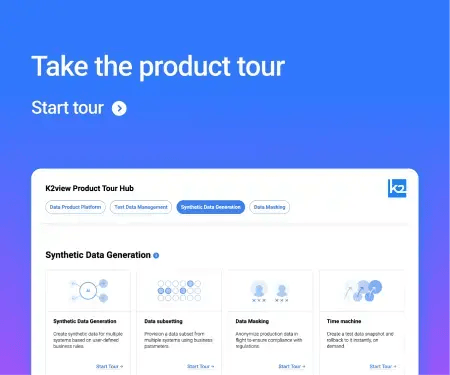
Experience K2view Test Data Management first-hand in our interactive product tour.


