

K2view named a Visionary in Gartner’s Magic Quadrant 🎉

Read More arrow--cta
Book a Demo
Start Free
Start Free

The complete guide to data agents

What are data agents? The bridge between agentic AI and enterprise data.

Last updated on December 18, 2025

What are data agents?

tableicon/Table of Contents

New! 2025 State of Test Data Management Survey 📊
Get the Survey Results arrow--cta

Data agents bridge agentic AI with trusted enterprise data, empowering systems to answer, decide, and act with enterprise-grade precision.

01

Key takeaways

  1. Data agents are specialized AI agents that connect agentic AI systems to enterprise data, retrieving and updating data while enforcing governance. 

  2. Most agentic AI projects fail in production not because of LLM capabilities, but because enterprise data for AI agents is inaccessible. 

  3. Minimum Viable Data (MVD) is a core principle where data agents provide only the smallest, most relevant dataset needed for each task – reducing AI costs, by limiting token usage, and increasing productivity, by delivering greater accuracy. 

  4. Entity-centric data products organize information around business entities (customers, orders, devices) rather than applications, providing the unified foundation data agents need.

  5. Data products implement agentic AI data protection by automatically applying access controls, data masking, audit logging, and compliance rules. 

  6. Organizations can deploy pre-built data agents for common scenarios or build custom agents with commercially available tools to address specific needs. 

  7. Data agents provide business context and autonomously determine what data to retrieve from which systems, through chain-of-thought reasoning

  8. Data agents support multiple use cases including conversational AI chatbots, back-office workflow automation, synthetic data generation, risk monitoring, and compliance auditing.

03

Why does agentic AI need better access to data?

Unlike chatbots designed to answer simple questions, AI agents can plan multiple steps, work with different tools, and complete complex tasks without a human in the loop

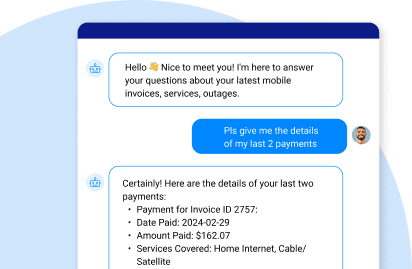
Consider AI customer service. To help a customer with a billing question, the agent may need to know about the user's account status, recent payments, active services, and billing history. This information sits in different systems: CRM platforms, billing databases, payment processors, and customer data warehouses. Traditional data architectures make it hard for AI agents to quickly form a complete picture.

What are the 4 main agentic AI challenges?

When  AI agents can't access the data they need, 4 major problems emerge: 

  1. Accuracy issues 

    When an agent receives incomplete, outdated, or conflicting information, it tends to make mistakes. For example, the customer service chatbot relying on that agent might reply that a payment was made when it wasn't, or suggest a service upgrade that the user already has. 

  2. Slow responses 

    It takes too long for an agent to call multiple systems and unify data. With conversational AI, delays of even a few seconds feel awkward and frustrating. 

  3. Rising costs 

    Large Language Model (LLM) usage fees are based on the amount of data processed. When LLM agents receive more information than they need, costs multiply quickly, especially when handling thousands of requests per day.

  4. Security and compliance risks 

    Giving AI agents access to entire databases needlessly exposes sensitive data – and makes compliance with CPRA, HIPAA, GDPR, and DORA European regulations so difficult.

If you want your GenAI to work, start with your data

Grounding GenAI in enterprise truth demands AI-ready data that’s fresh, integrated, and contextualized.

Here’s the Solution
GenAI

04

What are data agents?

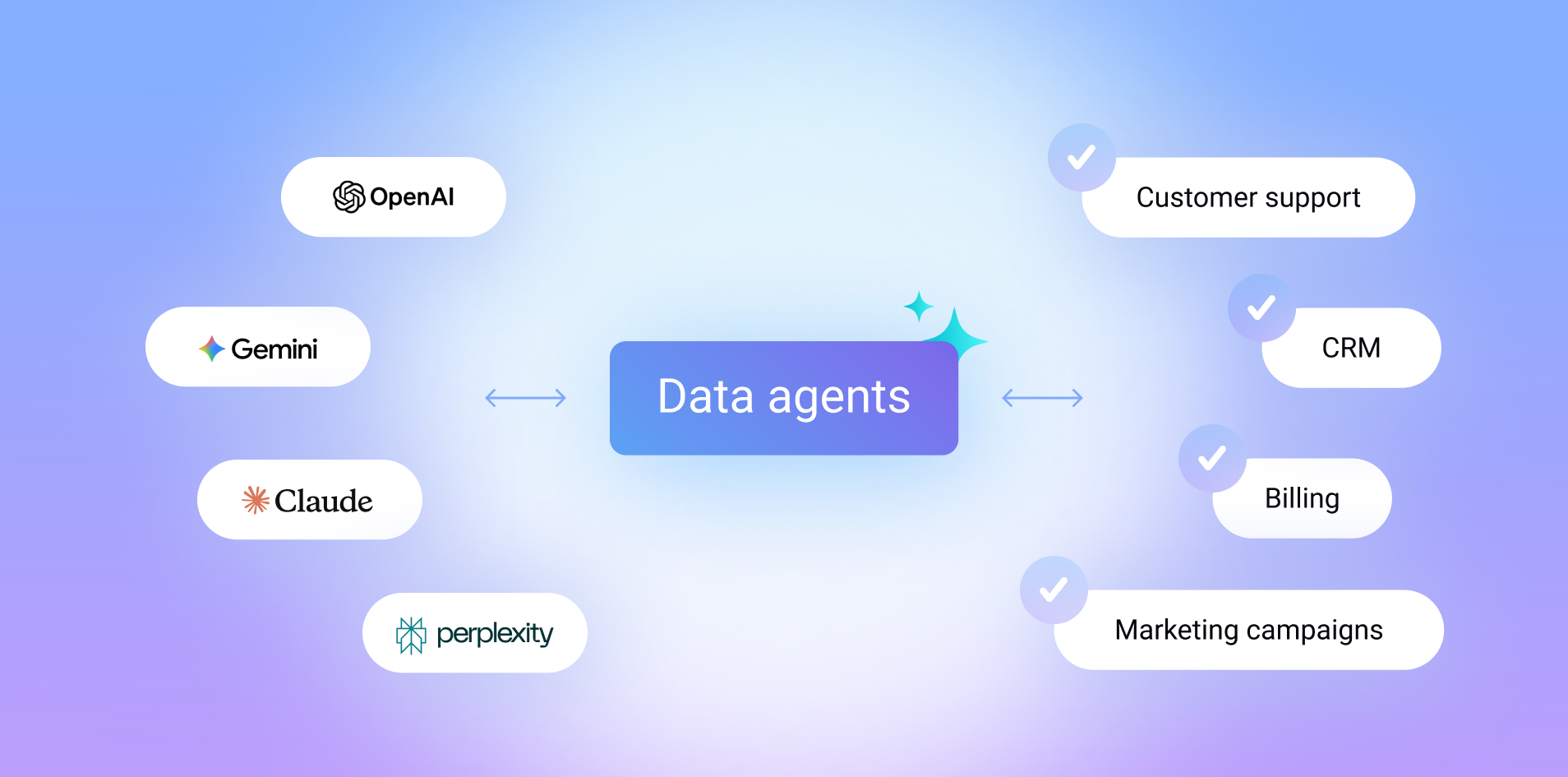
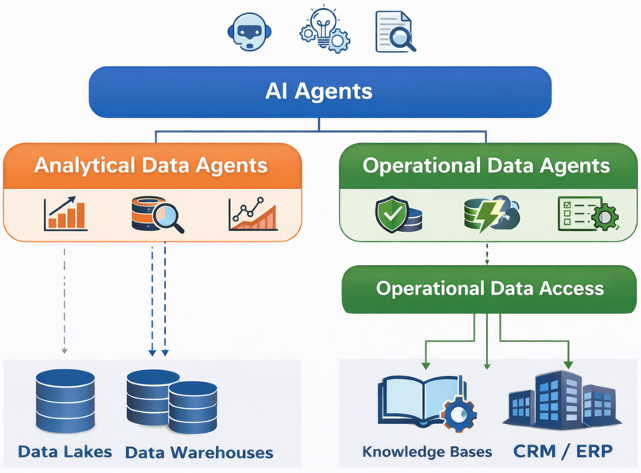
Data agents are specialized AI agents that focus on one critical job: connecting other AI agents to enterprise data. While an AI agent handles reasoning and decision-making, a data agent handles data access and operational actions.

Data agents work inside your company's agentic AI framework. On one hand, they interact with AI agents, understanding what data is needed for each task. On the other hand, they connect to data products and enterprise systems, retrieving information and executing actions. 

How are data agents different from traditional tools?

Unlike traditional data integration tools or APIs, data agents use AI to:

  • Understand a natural language request and figure out what data is needed 

  • Determine which systems or data sources contain that information 

  • Generate queries or API calls to retrieve the data 

  • Apply AI data governance and security rules automatically 

  • Transform and assemble the data into a useful format 

  • Execute updates or actions on systems of record when needed 

For example, when a customer service AI agent asks, "Why is this customer's bill higher this month?", the data agent would: 

  1. Identify the customer being discussed 
  2. Comprehend it needs billing information (current and previous bills, usage data, plan changes) 
  3. Retrieve this information from the relevant data products 
  4. Mask sensitive data on the fly 
  5. Format the response so the AI agent can understand it clearly 
  6. Deliver only the essential information needed to answer the question 
This all happens in seconds, without requiring someone to write custom code or create new API endpoints.

05

What is Minimum Viable Data (MVD)?

A key principle that guides data agents is called Minimum Viable Data (MVD), or providing the smallest, most relevant, dataset needed to perform a specific task.

You might think that giving AI agents more data would lead to better results. Actually, the opposite is true. Too much data creates noise, slows down processing, increases costs, and raises security risks.

MVD isn't about providing less data. It's about providing exactly the right kind and amount of data, in terms of: 

  1. Task relevance

    Only information directly needed for the current task is accessed and used. 

  2. Context richness

    Metadata and semantic structure help the agent understand what the data means.

  3. Data minimization

    Exposure to Persoanlly Identifiable Informatikomn (PII) and other sensitive data should be severly restricted to reduce privacy and compliance risks.

For instance, if a customer is calling about an Internet speed upgrade, the AI agent doesn't need a 5-year history of support tickets. It needs to know the current plan, available upgrade options, contract terms, and billing information. That's the minimum viable data required for this task.

Why context matters as much as content 

Minimal viable data without context lacks meaning. Rich metadata adds context by providing:

  • Meaning to each data field 

  • Understanding about the relationships between the different data elements  

  • Valid values and data types 

  • Business rules and constraints 

  • Data quality indicators 

MVD calls for minimum size but maximum understanding.  The data agent ensures that even a small dataset carries all the meaning needed to reason accurately.

06

Entity-centric data products

For data agents to work well, they need access to data organized in a specific way. This is where the entity-centric data product comes in, another crucial element of agentic AI best practices.

Traditional data systems organize information around applications or databases. An entity-centric approach organizes data around business entities such as a customer, order, invoice, or device.

What is an entity-centric data product? 

A data product is a self-contained unit that manages all the data for a specific business entity. For example, a customer data product brings together everything about a customer: their profile information, account details, purchase history, support interactions, preferences, and more.

Each data product: 

  • Retrieves data from all relevant source systems 

  • Syncs information in real time 

  • Includes semantic metadata and business rules 

  • Enforces governance and security policies 

  • Provides a unified view of that entity 

This synergy creates a live, reliable operational view that data agents can depend on. 

Why are traditional data architectures inadequate? 

Many companies try to support AI agents using data lakes or APIs. Both have significant limitations: 

Data lakes store huge amounts of information, which is great for analytics. But for agentic AI, they fall short due to: 

  • Stale data updated only in batches

  • Scattered information about each entity

  • Too much noise and irrelevant data

  • Lost meanings and relationships

  • Security risks posed by accessing entire data lakes

APIs are essential for system integration, but they can't serve as the primary data foundation for AI agents because: 

  • They're designed around how systems store data, not how businesses think about entities. 

  • Getting a complete picture requires calling many different APIs, which is slow and tedious.

  • You can’t build enough API endpoints to answer every possible question.

  • APIs expose fields without their semantic meanings or relationships.

  • It’s impractical to create a new API for each new agent question. 

Entity-centric data products solve these problems by providing unified, real-time, semantically-rich views of business entities.

07

Types of data agents

Data agents come in different varieties, each designed for specific purposes. You can use pre-built data agents or have them custom-made to answer your unique requirements. Common data agents include: 

1.    Conversational data agents 

Conversational data agents answer business questions instantly using live enterprise data. A business user might ask, "Which customers in the Northeast region increased their spending by more than 20% last quarter?"  

The conversational data agent understands the question, retrieves the relevant data, and provides an answer in seconds – so business users no longer have to wait for data analysts to write queries or generate reports. It makes data accessible to everyone in a democratic way. 

2.    Synthetic data agents 

Synthetic data agents generate realistic test data based on real production patterns. Lifelike, but fake, data is crucial for software development and testing, where teams need data that behaves like production data but doesn't contain any real customer information.

A synthetic data agent can create thousands of realistic customer records with proper relationships between accounts, transactions, and interactions – all while ensuring no real personal data is exposed. 

3.    Data compliance audit agents 

Data compliance audit agents scan test and development environments to find sensitive information that shouldn't be there. They can identify Personally Identifiable Information (PII) before it causes compliance problems, which directly supports agentic AI data protection.

For example, before releasing a new software version, the audit agent calls for PII masking, when required, to ensure that no real customer data accidentally makes its way into the test environment.

4.    Custom data agents 

Organizations can build their own customized data agents for specific business needs. Data agent builders enable teams to create agents tailored to their processes, data domains, and governance requirements.  

For instance, a healthcare company might build a data agent that helps doctors access patient information while automatically enforcing HIPAA compliance rules. A financial services company might create an agent that detects fraud by assembling relevant transaction patterns while protecting customer privacy. 

Learn more about customizing agents in section 10

08

How do data agents work?

Let's walk through a real example to see how data agents operate. Imagine a telco with an AI chatbot for customer service

A customer calls and says, "My bill is $50 higher than usual this month. Why is that?"

The customer service AI agent fielding this question needs to provide the right answer quickly. The step-by-step workflow might look something like this: 

  1. Understand the request 

    The AI agent understands this is a billing question that requires comparing the current month's charges with previous months. 

  2. Invoke the data agent 

    The AI agent asks the data agent for the necessary billing information for this specific customer. 

  3. Decide which data is most relevant 

    The data agent applies chain-of-thought reasoning to determine what information is required, for example: 

    Current month's bill with line-item details

    Previous month's bill for comparison 

    Any recent plan changes or add-ons 

    Usage information if relevant 

    Active services and features 

  4. Retrieve the data 

    The data agent accesses the customer's billing data product, which unifies information from multiple systems, such as the billing platform, usage databases, plan management, and payment systems. It then generates the appropriate queries and retrieves the data. 

  5. Apply governance 

    The data agent automatically applies any necessary data masking. For instance, it might hide payment card details while keeping transaction amounts visible, ensuring proper agentic AI data protection. 

  6. Assemble the response 

    The data agent packages the information in a structured format that includes: 

    Previous month: $85 total 

    Current month: $135 total 

    Difference: $50 increase 

    Cause: Roaming charges ($45) + activation fee ($5) 

    Context: Customer traveled abroad with active roaming

  7. AI agent response 

    The AI agent receives this clear, contextual information and can now explain to the customer: "I see your bill increased by $50 this month. That’s because you used international roaming while traveling, which added $45, plus a one-time activation fee of $5." 

The bottom line: The customer receives a clear, accurate, and satisfying answer in a matter of seconds.

09

How do data agents enhance enterprise security?

Security and compliance are critical concerns when AI agents access enterprise data. Data agents play a key role in maintaining security, making them essential for agentic AI data protection. 

Built-in governance 

Data agents enforce governance rules automatically. They apply: 

  • Access controls based on who is requesting the data 

  • Data masking to hide sensitive fields 

  • Audit logging to track what data was accessed and why

  • Privacy rules to ensure CPRA, HIPAA, GDPR, or DORA compliance

For example, if a junior customer service representative asks about a particular customer's account, the data agent might mask certain financial details that only senior staff can see. All of this happens transparently, without requiring the AI agent or the user to understand the complexity behind the security rules. 

Limiting data exposure 

By implementing minimum viable data principles, data agents significantly reduce risk. Instead of giving AI agents access to entire databases, data agents provide only what's needed for each specific task.

Leading consulting firms emphasize treating agents like new employees, giving them access only to what they need. Data agents make this practical by automatically determining and enforcing data minimization.

Monitoring and auditing 

Data agents create clear audit trails showing: 

  • What data was requested? 

  • Why was that data requested?

  • Which systems provided it?

  • How was the data transformed?

  • Who accessed it?

  • When was it accessed?

This visibility is essential for compliance and for investigating any issues that may arise.

10

How are data agents built and deployed?

Organizations can take different approaches to implementing an LLM agent architecture, depending on their needs and technical capabilities. 

Pre-built data agents 

For common use cases, pre-built data agents offer the fastest path to value. These agents handle standard scenarios like: 

  • Answering operational questions 
  • Generating synthetic test data 
  • Auditing for compliance 
  • Retrieving and transforming data 

Pre-built agents can be configured to work with your specific data products and systems without custom coding. 

Custom data agents 

For specialized needs, organizations can build custom data agents. Modern platforms provide low-code or no-code builders that make this accessible to business-oriented teams, not just developers. 

Creating a custom data agent typically involves: 

  1. Defining the purpose 

    What business problem will this agent solve? What questions should it answer or actions should it perform? 

  2. Identifying data sources 

    Which data products or systems contain the relevant information? 

  3. Configuring the logic 

    How should the agent reason out data requests? What are the rules for data access and transformation? 

  4. Setting governance rules 

    What security and compliance policies must the agent enforce? 

  5. Testing and refining 

    Which scenarios should the agent be run through to ensure it works correctly and securely? 

Integration with agentic frameworks 

Data agents operate inside your organization's broader agentic AI framework. This might be built on platforms like Microsoft Copilot Studio, Salesforce Agentforce, AWS Bedrock, or open-source frameworks.

The key is that data agents work alongside other agents, including LLM agents, each specializing in different aspects of the workflow. While some agents handle conversation, others make decisions, and data agents ensure everyone has access to the right information. 

11

Real-world impact and business value

Organizations implementing data agents are seeing significant benefits across multiple dimensions, including: 

  1. Faster time to value 

    Companies report that AI agents can turn data requests into working solutions in minutes instead of days. This acceleration means businesses can respond to market changes more quickly and serve customers better. 

  2. Cost reduction 

    By providing only minimum viable data, data agents dramatically reduce the token costs associated with large language models. Organizations achieve up to 70% cost reduction by automating workflows with agentic AI systems, according to Arcade.dev's 2025 agentic AI adoption analysis.1 

  3. Improved accuracy and efficiency 

    When AI agents receive clean, contextual, relevant AI data instead of raw database dumps, their accuracy and efficiency improve substantially. According to PwC’s 2025 survey2, companies adopting AI agents report a: 

    66% increase in productivity 

    57% reduction in cost  

    55% faster decision-making 

    54% improved customer experience 

  4. Better compliance 

    Automated governance through data agents helps companies maintain compliance more consistently than manual processes. Audit agents can catch issues before they become problems, and built-in data masking ensures sensitive information stays protected, supporting comprehensive agentic AI data protection. 

  5. Enabling new capabilities 

    Data agents unlock use cases that weren't practical before. For example, one telecommunications company deployed data agents that let field technicians ask complex questions about network equipment in natural language, accessing real-time data from dozens of systems instantly. 

12

The future of data agents

The field of data agents is evolving rapidly, particularly as generative AI adoption accelerates across enterprises. Several trends are shaping what comes next. 

  • Multi-agent collaboration 

    Future systems will feature multiple specialized agents working together. A multi-agent LLM allows different agents to handle extraction, cleaning, analysis, and action, coordinating their efforts to tackle complex scenarios. For instance, in a supply chain optimization system, one data agent might monitor real-time inventory, while another forecasts demand, and a third optimizes delivery routes, all sharing information as needed. 

  • Continuous learning 

    Next-generation data agents will learn from each interaction, improving their understanding of data patterns and user needs. They'll get better at predicting what information will be needed and preparing it proactively in a react agent LLM. 

  • Broader integration 

    Data agents will integrate with more systems and data sources, including unstructured content through Retrieval-Augmented Generation (RAG), Internet of Things sensor data, and external information sources. This will make GenAI data more accessible and actionable across the enterprise. 

  • Autonomous optimization 

    LLM-powered automomous agents will automatically optimize their own performance, adjusting queries, caching strategies, and data preparation based on usage patterns and performance metrics. 

13

Getting started with data agents

For organizations ready to implement data agents, here's a practical path forward: 

  1. Identify high-value use cases 

    Start with scenarios where agentic AI can deliver clear business value and where data access is currently a bottleneck. Common starting points include: 

    – Customer service and support 

    – Operational reporting and monitoring 

    – Fraud detection and prevention 

    – Personalized campaigns and customer interactions 

  2. Assess your data foundation 

    Evaluate your current data architecture. Do you have entity-centric data products, or is your data scattered across lakes and APIs? Understanding your starting point helps you plan the right approach. 

  3. Start small and prove value 

    Begin with a focused pilot that demonstrates clear value. This might be a single data agent supporting one specific workflow. Success in a pilot builds momentum for broader adoption. K2view provides a comprehensive platform for implementing data agents through its  Data Product Platform and Data Agent Builder. Organizations can start with pre-built agents or quickly create custom agents using no-code tools that integrate seamlessly with entity-centric data products. 

  4. Establish governance 

    Define clear policies for how data agents should access and use data. This includes security rules, compliance requirements, and data quality standards. 

  5. Measure and expand 

    Track key metrics like response time, accuracy, user satisfaction, and cost savings. Use these insights to refine your approach and expand to additional use cases. 

14

Best practices for data agent success

Organizations that succeed with data agents follow 6 best practices, which align with broader agentic AI best practices: 

  1. Design around business entities 

    Organize your data around business entities (customers, orders, assets) rather than technical structures (databases, APIs). This practice makes data more accessible and meaningful to AI agents. 

  2. Implement the concept of minimum viable data 

    Always ask, “What is the smallest dataset that contains everything needed for this task?” Ruthlessly eliminate unnecessary information. 

  3. Enrich data with context 

    Don't just provide raw data fields. Include semantic metadata that explains what the data means, how fields relate, and what business rules apply. 

  4. Automate governance 

    Build security and compliance rules into your data agents from the start. This “stitch in time” is much easier than trying to add them later, and it's essential for agentic AI data protection. 

  5. Monitor continuously 

    Track how your data agents perform well and where they struggle. This record reveals opportunities to improve data quality, add missing context, or refine agent logic. 

  6. Foster collaboration 

    Bring together data teams, AI teams, and business domain experts. Successful data agents require a thorough understanding of both the technical data landscape and the business problems being solved. 

15

Conclusion

Agentic AI represents a fundamental shift in how software works. Instead of humans telling computers exactly what to do every step of the way, AI agents can reason, plan, and act autonomously. This phenomenon promises to transform business operations, but only if the data agents can access the right data for agentic AI.

Data agents are the essential bridge connecting agentic AI to operational data quickly, accurately, cost-effectively, and securely. By implementing concepts like minimum viable data and entity-centric data products, and by operationalizing these principles through intelligent data agents, organizations can move agentic AI from promising pilots to production-scale success stories.

The K2view Agentic Data Product Platform delivers entity-centric data products synchronized in real-time with systems of record. The K2view Data Agent Builder enables organizations to quickly deploy pre-built data agents or create custom agents using no-code tools – making enterprise-grade agentic AI accessible to businesses of all sizes.

Behind every K2 data agent there is at least one data product – a live, secure representation of a specific business entity (such as a customer, order, or device). The data product collects, unifies, and syncs the minimal viable data for the business entity from the source systems into a single, contextual, and ready-to-use view.

Agentic Data Product Platform

All data products are created and managed within the platform, which empowers organizations to build and deploy their own data products and data agents. The K2view solution provides a flexible foundation for securely exposing data products as MCPs or APIs, depending on the integration pattern or AI framework used.  

The companies that get data agents right will have a significant competitive advantage. Their agentic AI will be more accurate, more responsive, and more trustworthy than competitors still struggling with data access and protection. And they'll be able to deploy new capabilities agilely, rapidly responding to changing business needs.

As agentic AI continues to evolve, data agents will become even more critical. They're not just a technical component; they're a strategic capability that determines whether your agentic AI initiatives succeed or fail.

The question isn't whether you’ll need data agents. It’s how quickly can you implement them and begin to capitalize on the business value they unleash. 

Data Agents FAQ

What is the difference between data agents and AI agents?

AI agents are autonomous software systems that can reason, plan, and execute complex tasks. Data agents are specialized AI agents that focus specifically on connecting other agents to enterprise data. While an AI agent might handle customer interactions or business decisions, a data agent ensures that AI agent receives accurate, contextual, and governed data for AI agents to work with. Data agents retrieve information from data products, apply security policies, and deliver only the minimum viable data needed for each task. 

How do data agents contribue to agentic AI accuracy and efficiency?

Data agents improve accuracy by providing clean, contextual, and relevant information instead of raw database dumps. They implement minimum viable data principles, which means they deliver only the essential information needed for a task, enriched with semantic metadata that helps AI agents understand relationships and business rules.

This reduces noise and confusion that can lead to AI hallucinations or incorrect responses. According to a 2025 AI agent survey by PwC, of those companies adopting AI agents, nearly two-thirds report increased productivity, while over half report improved cost savings, faster decision-making, or enhanced customer experience. 

What is Minimum Viable Data (MVD)?

Minimum viable data is the smallest, most relevant dataset an AI agent needs to complete an action or answer a question. It's not about giving the agent less data, but about giving it the right data with the right context. MVD combines task relevance (only information directly needed), context richness (metadata and semantic structure), and data minimization (reducing security and compliance risk). Data agents implement MVD by analyzing each request and extracting precisely what's needed from entity-centric data products. 

How do data agents handle security?

Data agents enforce security and compliance by:  

  • Applying role-based access controls, to ensure users only see the data they're supposed to see.

  • Automatically masking data, to hide sensitive fields like payment card numbers or personal identifiers. 

  • Maintaining detailed audit logs of all data access. 

  • Adhering to data minimization principles, which reduce risk by exposing only the data necessary for each task. 

These tasks make data agents essential for agentic AI data protection in regulated industries. 

Why do data agents need entity-centric data data products?

Entity-centric data products organize information around business entities (like customers, orders, or devices) rather than around applications or databases. Each data product unifies all relevant data for a specific entity from multiple source systems, keeps it synchronized in real-time, and includes semantic metadata and business rules. Entity-centric data products provide the unified, contextual, and reliable operational views that enable accurate AI agent reasoning. Without them, data agents would need to stitch together fragmented information from multiple systems, which is slow, error-prone, and not scalable. These benefits explain why entity-centric architecture is one of the key agentic AI best practices. 

Can organizations build custom data agents?

Yes, organizations can build custom data agents tailored to their specific needs. Modern platforms, like the K2view Data Agent Builder, provide no-code or low-code tools that make it possible for business teams to create agents without heavy technical experience. Custom data agents can be designed for specialized workflows, specific data domains, unique governance requirements, or industry-specific compliance needs. For example, a healthcare organization might build a data agent that enforces HIPAA rules while helping doctors access patient information. 

How do data agents reduce AI costs?

Data agents reduce costs by implementing minimum viable data principles. Instead of passing entire database tables or large document collections to large language models, data agents extract only the essential information needed for each task. Since LLM pricing scales with the amount of data processed (token usage), smaller and more focused datasets directly reduce costs. Organizations achieve up to 70% cost reduction by automating workflows with agentic AI systems, according to Arcade.dev's 2025 agentic AI adoption analysis. Additionally, by reducing unnecessary data processing, data agents also improve response times and system performance. 

What is the difference between APIs and data agents?

APIs (Application Programming Interfaces) expose specific data or functions in a structured way. They’re designed around how systems store data, not how businesses reason about entities. Data agents, on the other hand, are intelligent systems that understand business context, reason about data needs, and assemble information from multiple sources. While APIs require developers to know exactly which endpoints to call and how to combine results, data agents can interpret natural language requests and automatically determine what data to retrieve, from where, and how to transform it. Data agents use APIs as one of many tools, but provide a much higher level of abstraction and intelligence. 

How do data agents support generative AI?

Data agents play a critical role in generative AI adoption by making GenAI data accessible and safe. They provide the operational data that makes generative AI applications accurate and useful in business contexts. For retrieval-augmented generation (RAG) applications, data agents retrieve relevant context from enterprise systems. For a customer service chatbot, data agents supply current customer information. For AI-powered analytics, data agents assemble the right datasets. Throughout all of this, data agents ensure that agentic AI data protection policies are enforced, sensitive information is masked, and only authorized data is exposed to generative AI models. 

What industries benefit most from data agents?

Data agents provide value across all industries, but they're particularly impactful in sectors that deal with complex, distributed operational data and strict compliance requirements. Financial services organizations use data agents to detect fraud, serve customers, and issue regulatory reports, all while maintaining data security. Healthcare providers use them to give clinicians access to patient information while enforcing HIPAA compliance. Telcos use data agents for human agent assist, billing inquiries, and network operations. Retail and e-commerce businesses use them for personalized customer experiences. Essentially, any organization with AI data spread across multiple systems can benefit from data agents. 

What are data agents? Here’s the Solution