




.jpg)
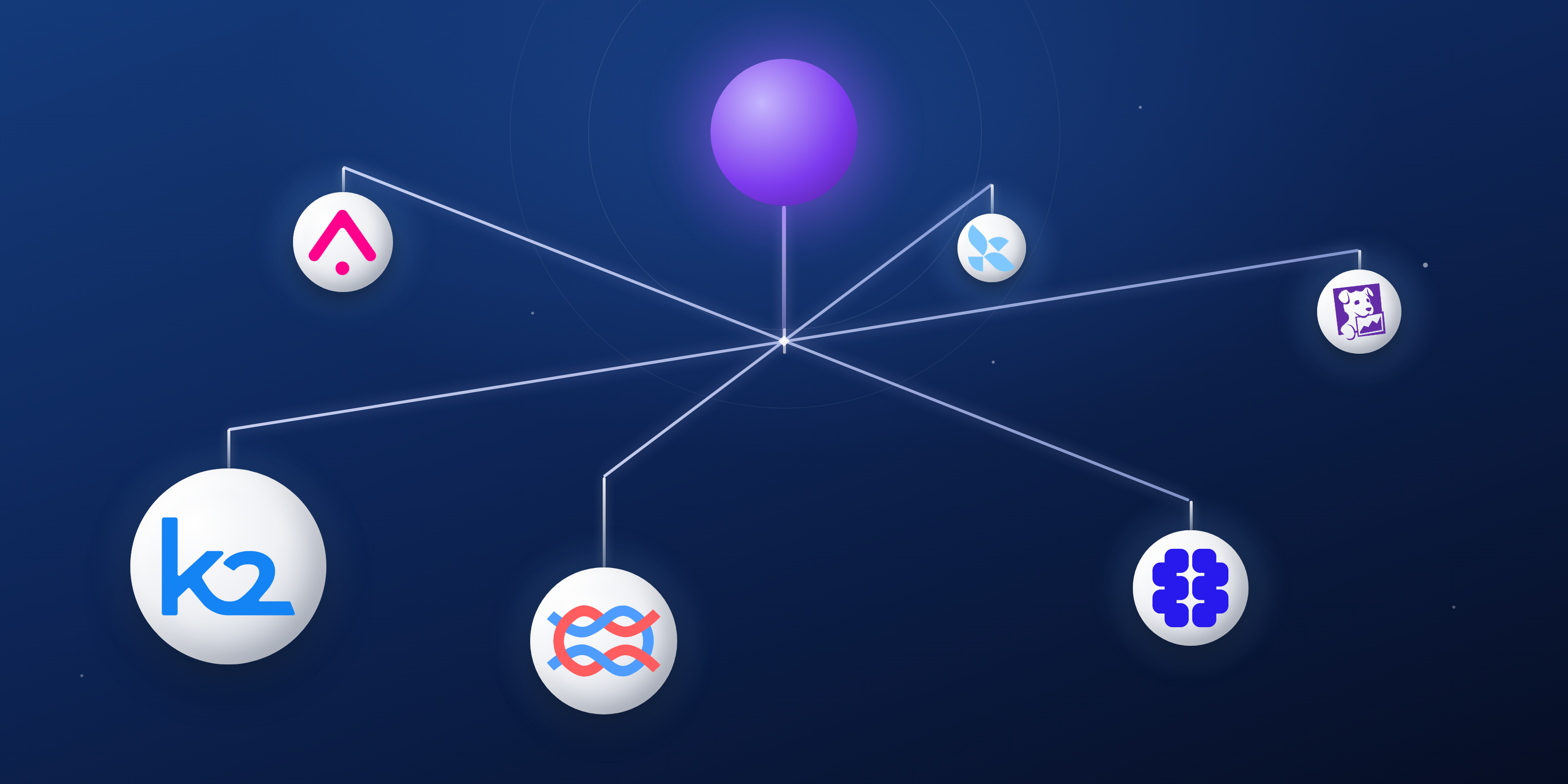


Table of contents
The best AI evaluation and observability tools score AI outputs, record production behavior, and help you reproduce the context behind a failure.
Key takeaways
- AI evaluation scores output quality, while AI observability records what the application did in production.
- Traditional testing still applies to AI applications, but they need an evaluation layer on top, because answers, context, prompts, and models all keep changing.
- Six criteria separate the tools in this category, and two of them carry extra weight for AI running on sensitive business data.
- Most platforms trace and score well but can’t provision the data an eval case runs on or restore the context behind a production answer.
- The six tools reviewed here are K2view, Arize, Langfuse, LangSmith, Braintrust, and Datadog.
Why AI evaluation and observability
Analyst Gartner, in its February 2026 report, Market Guide for AI Evaluation and Observability Platforms, estimates the current market at US$200M and expects 60% of software engineering teams to be using AI evaluation and observability platforms by 2028, up from 18% in 2025.
Traditional software testing assumes you can define expected behavior with reasonable precision. AI applications make that more difficult, because:
- Answers can change, because the model may respond differently to the same question across runs.
- Context changes, because the customer records, policies, and tools the application reads look different today than they did yesterday.
- Prompts change, because someone rewrites them.
- Models change, because providers retire versions on their schedule, not yours.
That doesn’t make traditional testing obsolete. It means AI applications need an evaluation layer on top of it, one that measures output quality while those conditions shift.
A test compares one output to one expected result and reports pass or fail. An AI evaluation scores an output on several qualities at once: correctness, relevance, policy compliance, and tone. Each quality gets a score, and the scores combine into one result. Gartner draws the line simply. Checking a calculator is simple, because there is only one right answer. Grading an essay, however, takes judgment.
AI observability covers the other half. It records what the application does in production, including every prompt, retrieval, tool call, model call, token, and response.
Neither works alone. Evaluation built on invented scenarios checks situations that never happen. Observability without scoring tells you what the AI said, but not whether it was right.
What’s the business impact of AI evaluation and observability?
Two things are pushing enterprises to invest in AI evaluation and observability:
1. A bad AI answer is bad for business
In customer service, billing disputes, claims handling, and loan processing, every answer moves a customer’s money, coverage, or access.
A wrong answer approves a refund that shouldn’t be approved or denies a claim that should have been paid.
The application doesn’t crash and no monitoring alert fires, so the system looks healthy while the answer quality drops.
2. Auditors want to see solid evidence
A written AI policy establishes what the AI was supposed to do. A complete trace shows what it did, including what it read, which rules applied, what the model returned, and what happened next. During an audit or investigation, that evidence can be critical.
Teams must therefore evaluate not only what the AI said, but what context it used, what it decided, which tools it invoked, what action it took, and what changed as a result.
Most enterprises can’t produce it yet. In our 2026 State of Enterprise Data Compliance survey, only 2% of AI and GenAI environments were rated fully compliant, the lowest score of any environment surveyed.
This is where evaluation and observability meet AI data governance: governance decides what the AI can see, and the evaluation loop documents how it used what it saw.
Both pressures land on the same requirement. Teams need to score output quality and keep the evidence behind every answer.
Top criteria to look for in an AI evaluation and observability tool
AI evaluation and observability tools differ most in how they handle:
- Realistic eval cases
Build your cases from masked production data. Real records carry the incomplete and contradictory situations that break AI applications, while invented cases only cover what you already thought of. - Reproducible context per case
Keep the data behind each case so you can load it again. When a score changes, you’ll know your change caused it. - One set of criteria before and after launch
Score development and production the same way. Otherwise, you can’t tell a real quality drop from a change in measurement. - Full-trace capture
Record every step of every interaction, not just the question and the answer. Retrievals and tool calls are where most failures start. - Replay against saved context
Capture the exact session context, including customer records, model version, available tools, and active policies. Without it, post-mortems turn into guesswork. - Privacy controls on eval data
Mask and tokenize the customer data that lands in prompts, traces, and eval datasets. Treat it as production data, because that’s what it is.
Most tools handle full-trace capture and consistent criteria well, so those criteria won’t narrow your list. If your AI applications run on sensitive business data that changes daily, weight criteria 2 and 5 more heavily. Reproducible context and replay are what let you explain a specific bad answer weeks after it happened.
AI evaluation and observability tools at a glance
The table below scores the six leading AI evaluation and observability tools against the criteria that separate them, leaving out the ones they all handle well.
|
Tool |
Best for |
Open source |
Deployment |
Eval data provisioning |
Context replay |
|
1. K2view |
Enterprises running AI on live customer data |
No |
Cloud, |
Native |
Full AI context delivery |
|
2. Arize AX and Phoenix |
Teams extending ML monitoring to LLMs |
Phoenix only |
Cloud, |
Bring your own |
Prompt replay only |
|
3. Langfuse |
Open-source tracing with data residency control |
Yes (MIT) |
Cloud, |
Bring your own |
Prompt replay only |
|
4. LangSmith |
LangChain and LangGraph projects |
No |
Cloud, hybrid, |
Bring your own |
Prompt replay only |
|
5. Braintrust |
Evaluation-first development and CI/CD gates |
No |
Cloud, enterprise, on-prem |
Bring your own |
Prompt replay only |
|
6. Datadog LLM Observability |
Existing Datadog customers |
No |
Cloud |
Bring your own |
Not offered |
Most of these tools expect you to supply the eval dataset yourself, and most can re-run a prompt from a stored trace without restoring the data the original answer was based on. The section below explains how each one works and where it fits.
Best AI evaluation and observability tools for 2027
The listing below explains how each tool is built and who it’s built for, followed by Pros and Cons.
1. K2view
K2view organizes data by customer rather than by system. Each customer’s data, history, and permissions from every source sit together in their own Micro-Database™, enabling an automated AI evaluation and observability loop to capture the operational context behind an interaction and reproduce it later. Before deployment, it generates synthetic cases, including multi-turn conversations, and scores them against golden answers. In production, the same criteria run against live traffic, and any interaction can be preserved as a snap and replayed in a lower environment under its original conditions. K2view suits enterprises running AI on live customer data spread across multiple systems.
Pros
-
-
- Preserves production interactions as snaps with their point-in-time context and configuration, so a failure replays in a lower environment and becomes a permanent regression case
-
Cons
-
-
-
Sits inside a broader data platform, so it’s a heavier footprint than a drop-in tracing SDK
-
Targets enterprises with complex, multi-source data, and does more than most teams need to instrument a single LLM call
-
-
2. Arize AX and Phoenix
Arize collects traces with OpenTelemetry, using the OpenInference conventions for naming spans – the individual steps recorded inside a trace – so the data arrives in a standard format instead of a proprietary one. The same stored spans feed live monitoring and after-the-fact evaluation, with Phoenix as the open-source component and AX as the commercial platform. Arize suits teams already running ML monitoring who are adding LLM and agent workloads.
Pros
-
-
-
Builds on OpenTelemetry and OpenInference, so instrumentation isn’t locked to one vendor
-
Combines tracing, evaluations, experiments, drift detection, and explainability in one platform
-
-
Cons
-
-
-
Reserves the fullest governance and deployment controls for the enterprise tier
-
Splits capability across Phoenix and AX, and charges per span, so costs climb as trace volume grows in production
-
-
3. Langfuse
Langfuse ships as a stack you run yourself: two application containers backed by Postgres for transactional data, ClickHouse for traces and scores, Redis for queuing, and object storage for raw events. Incoming traces are written to object storage first and ingested asynchronously, so a spike in traffic doesn’t drop data or stall the UI. ClickHouse acquired Langfuse in January 2026, but the MIT license, self-hosting, and the roadmap all stayed in place. Langfuse suits teams that want tracing, prompt management, and evaluation inside their own infrastructure.
Pros
-
-
-
Runs self-hosted with no usage caps to meet data residency requirements
-
Covers prompt management, dataset handling, and cost tracking alongside tracing
-
-
Cons
-
-
-
Requires users to run and maintain the supporting data infrastructure when self-hosted
-
Doesn’t handle scoring as well as Braintrust or other evaluation-first tools
-
-
4. LangSmith
LangSmith reads the callbacks that LangChain and LangGraph already emit, so an agent’s steps arrive as a nested trace with no added instrumentation. Any trace can become a dataset example, and evaluators score it before or after deployment. LangSmith suits anyone already building on LangChain or LangGraph.
Pros
-
-
-
Fits LangChain and LangGraph tightly, with almost no integration work
- Supports human review through annotation queues and datasets
-
-
Cons
-
-
-
Charges per seat and per trace, so costs grow quickly as volume scales
- Offers less advantage to teams outside the LangChain ecosystem
-
-
5. Braintrust
Braintrust stores traces in Brainstore, a database it built for AI payloads, where spans land in object storage and a streaming engine indexes them for search. An AI span runs far larger than a conventional observability span, which is what breaks general-purpose databases at production volume. Evals are defined in code as a dataset, a task, and a set of scorers, so the same definition runs locally and as a release gate in CI. Braintrust suits teams that want evaluations to behave like a test suite.
Pros
-
-
-
Puts evaluation first, with CI/CD gates that catch regressions before merge
-
Converts a production trace into an eval case in one step
-
-
Cons
-
-
-
Jumps sharply from the free plan to the first paid tier
- Restricts self-hosting to enterprise deployments
-
-
6. Datadog LLM Observability
The Datadog LLM Observability SDK writes spans into the same backend as Datadog APM, so a model call appears inside the same distributed trace as the surrounding database queries and service calls. Layered on top are prompt clustering, cost and latency monitoring, and security scanning. Datadog LLM Observability suits organizations already standardized on the Datadog platform.
Pros
-
-
-
Correlates agent behavior with the surrounding application and infrastructure in one trace
-
Adds no new vendor, procurement cycle, or contract for existing Datadog customers
-
-
Cons
-
-
-
Gets expensive at production span volume, on top of existing APM spend
-
Trails the specialists on evaluation, so most teams pair it with a second tool
-
-
No single tool here wins outright, because each was built for different starting points: existing ML practices, open-source stacks, frameworks, release pipelines, or APM deployments. The right one depends on where your AI applications already run and how much of their context you need to keep.
Choose your AI evaluation and observability tool wisely
Most tools on the above list handle tracing and scoring well. The gap shows up later, when you have to explain a specific bad answer from three weeks ago.
At that point, for example, you may need the invoice, payment status, policy, model version, and tools the agent could reach that very day. A transcript gives you none of that. Logs record what happened, but they can’t recreate the conditions that produced it.
Use the six criteria described above as your checklist and decide how much weight reproducibility deserves in your environment. The more your AI applications touch live customer data, the more it matters. Being able to reproduce a failure is what turns AI quality from an opinion into something you can measure and fix.
Book a demo to see how K2view evaluates, observes, and replays AI in production.


