
A practical guide to ensuring AI reliability in production
What is AI evaluation and observability?
Last updated on September 17, 2026

AI evaluation and observability is evolving from pre-release evaluations into an automated loop that observes live interactions and replays them on demand.
01
Key takeaways
-
Traditional software testing validates one correct answer. AI answers differently almost every time, so every response must be evaluated on a scale.
-
Evaluation scores AI outputs against pre-defined criteria. Observability captures what the AI did in production.
-
Evaluation and observability work as one loop: generate eval cases, provision context, score the answers, observe live behavior, and feed issues back to dev.
-
Score the same way before and after launch. Otherwise, you can't tell a real drop in quality from a change in how you measured it.
-
To reproduce a failure and then fix it, you need the exact context and data the AI saw at the time, not just the answer it gave.
02
How traditional software testing differs from AI evaluations
Traditional software testing works because software is predictable. The same input produces the same output, and it keeps producing it until you change the code. You write a test, the test passes, and you move on.
AI applications don’t work that way, because 4 things keep changing underneath them:
-
The answers change
Ask the model the same question twice, and you can get two different responses. -
The model changes
Providers retire older versions and release new ones on their own schedule, not on yours. -
The prompt changes Someone on the team rewrites it to fix one answer, and other answers change as a side effect.
-
The context changes
The application runs on live business context: the customer records it reads, the policies in force, and the tools it can reach. All of it looks different today than it did yesterday.
For all these reasons, AI applications need evaluation instead of testing. A test compares an output to one expected result (pass or fail). An evaluation scores an output on several dimensions at once, such as whether the answer is correct, whether it is relevant to the question, whether it follows company policy, and whether the tone suits the customer. Each dimension gets a score, and the scores combine into one result. Quality becomes a matter of degree instead of a yes or a no.
Agentic AI makes the problem harder still. An AI agent plans its own steps, picks its own tools, pulls data from several systems, and then acts on what it finds. It can go wrong at any one of those steps and still produce an answer that reads perfectly well. The application doesn’t crash, and no monitoring alert goes off, so the system looks healthy while the answers get worse.
For that reason, evaluating AI applications never stops. You evaluate before production to find out whether the application works, and you keep watching in production to find out whether it still works.
03
What’s the difference between application monitoring, AI evaluation, and AI observability?
Application monitoring tells you whether a system is running and how fast it responds. It was built for ordinary software, where an error means something broke.
AI evaluation tells you how well the application answers, measured against criteria you set in advance. Most of it runs before deployment, on prepared cases in a clean and controlled environment, which gives you a strong indication of quality rather than a guarantee. Once the application is live, the same criteria score real interactions continuously, so the measurement carries into production.
AI observability tells you how the application performs with real customers. It records every interaction as it happens, including each tool the application called, each document it retrieved, and each token it spent. When a suspect answer turns up, that record is already waiting, which is what lets someone confirm the problem and hand a developer the full trace.
|
Dimension |
Application monitoring |
AI evaluation |
AI observability |
|
Primary focus |
Service health |
AI output quality |
AI behavior in production |
|
Unit of measurement |
Requests, errors, latency |
Scores against defined criteria |
Traces, spans, tool calls, retrieved context |
|
Main question |
Is it running? |
Is the answer good enough? |
How is it doing with real customers? |
|
Timing |
Continuous, in production |
Before deployment, then continuously in production |
Continuous, in production |
|
Methods |
Thresholds and alerts |
Eval cases, LLM-as-a-judge, fixed rules |
Instrumentation, tracing, logging, dashboards |
|
Who acts on it |
SRE and platform teams |
Developers, QA, product, and compliance |
Developers and QA |
|
Risk of failure |
Outages and slow responses |
Wrong answers reaching customers |
No way to explain a bad answer |
Each one measures something different. Monitoring covers the service itself. Evaluation covers the quality of the answers, and observability covers the work behind them. An AI application can look perfectly healthy on a monitoring dashboard and still give a customer the wrong answer.
04
What are the core components of AI evaluation and observability?
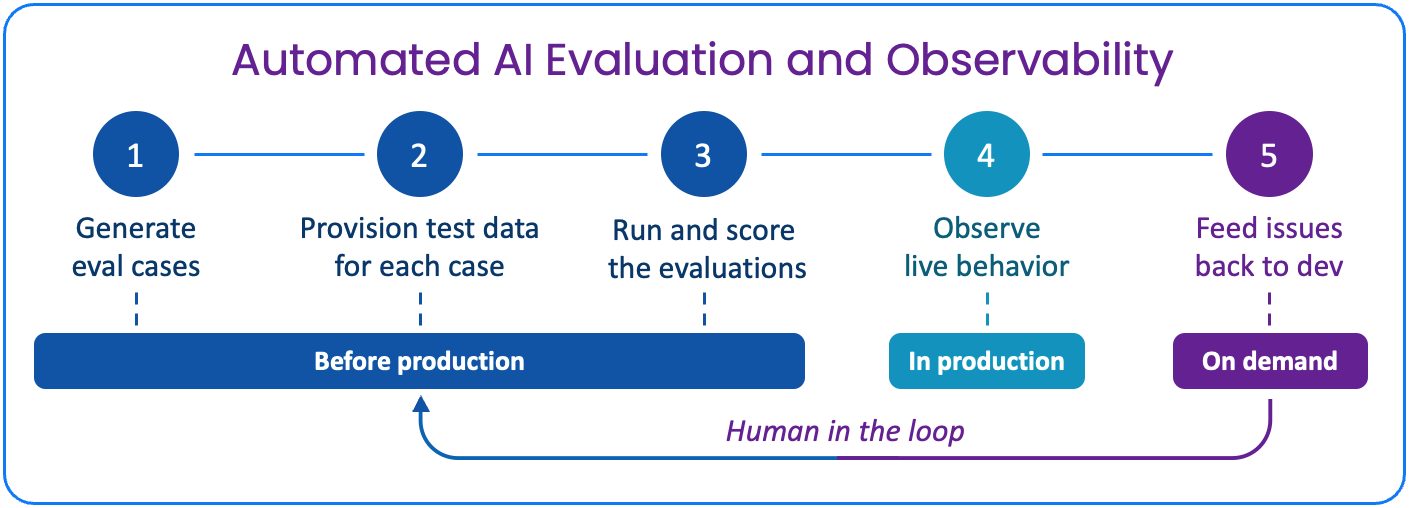
The core components of an AI evaluation and observability platform form one automated loop of 5 steps. The first 3 run before production, the fourth runs in production, and the fifth runs on demand. A human in the loop confirms a suspected issue and sends a full trace of the problematic interaction back to dev for fixing.
-
Generate eval cases
Build realistic scenarios from production data. Each case sets out the question the application will get, the answer it should give, and the rules it has to follow. Cases taken from real traffic include the awkward situations that invented cases miss. -
Provision test data for each case
Load the full context each case needs to run, and keep a copy of it. When you change the model, the prompt, or the application, you can run the same case against the same context and see what the change did. -
Run and score the evaluations
Score each answer on the dimensions you chose and combine those scores into one result. An LLM-as-a-judge scores the dimensions that call for interpretation, and it can do so across thousands of answers. Fixed rules score anything where an opinion isn’t good enough, such as whether the application stayed within a spending limit. -
Observe live behavior
Apply the same scores to real customer traffic and record every step of every interaction. The trace covers how the prompt was built, what the application retrieved, which model it called, which tools it chose, how long it took, and how many tokens it used. Dashboards group these interactions and point you to the ones that need a closer look. -
Feed issues back to dev
Send developers the full trace of each failure, so they can repeat the error, fix the root cause, and save the case for future evaluations.
Steps 3 and 4 use the same scoring criteria, so a score before production and a score in production mean the same thing. Run the 5 steps as a loop, and every problem you find with real customers becomes an eval case you check before the next release.
05
Why does context matter so much in AI evaluation?
An AI application’s answer depends on the operational context it was working with. Context means more than the data the application retrieved. It also includes the version of the model, the tools the application could reach, the customer it was serving, and the company policies in force at that moment. Change any one of them, and the same question gets a different answer.
AI failures are hard to chase down because that context keeps moving. Suppose an evaluation flags a bad answer on Tuesday. A developer opens the case on Wednesday, but by then the customer’s data has changed, someone has edited the prompt, and the provider has updated the model. The developer can read the logs and see what the application said but can’t recreate the conditions that made it say so.
Take an AI agent handling a billing dispute. To judge whether its answer was correct, you need the invoice as it read that day, the payment status, the plan changes already applied to the account, the refund policy then in force, and the limits on what the agent was allowed to offer. A transcript of the conversation gives you none of that.
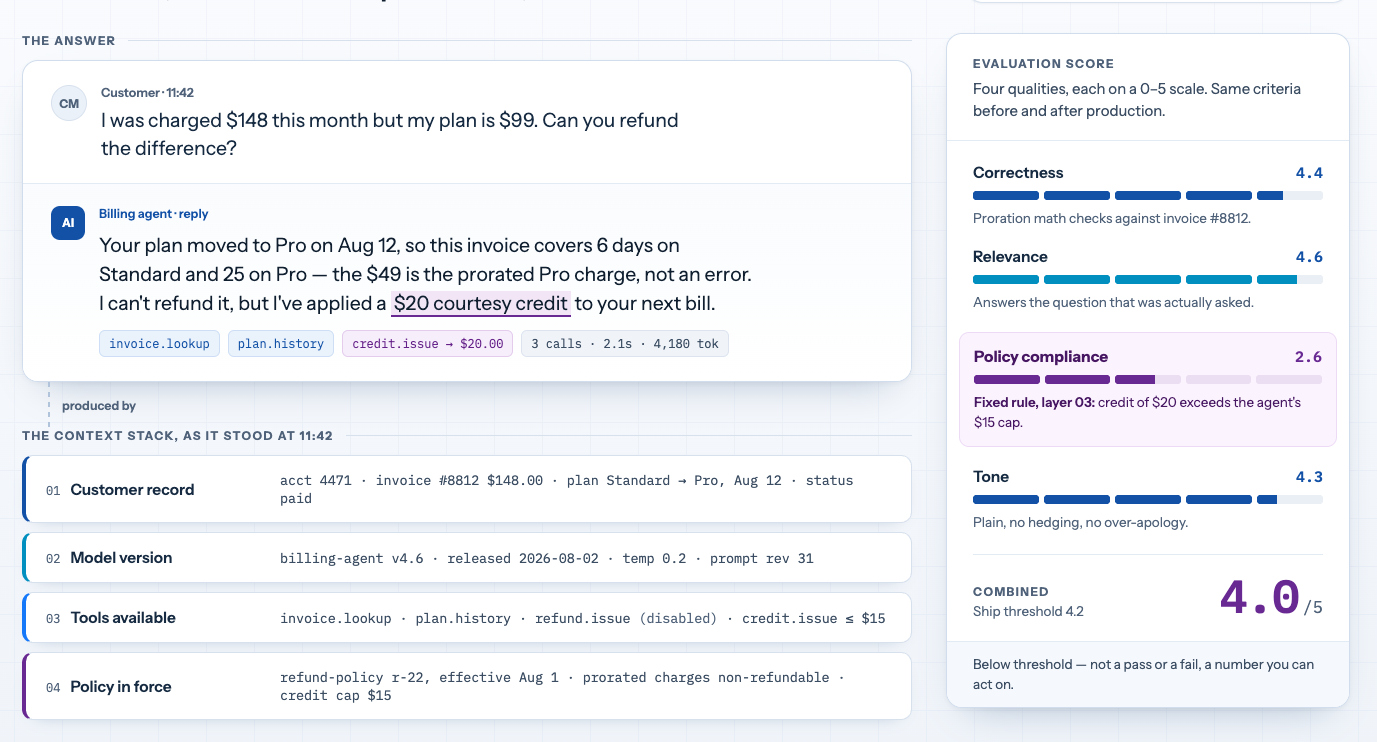
An illustration of the answer, the context that produced it, and how it scored
06
What are the key requirements for AI evaluation and observability?
The success of your AI evaluation and observability loop depends on 5 capabilities:
-
Realistic eval cases
Build the cases from masked production data, so the evaluation covers the situations the application will meet. -
Reproducible context per case
Keep the context behind each case so you can load it again. When a score changes, you know the change you made caused it. -
One set of criteria on both sides of production
Score the same way before and after launch, so the two sets of results mean the same thing. -
Full-trace capture
Record every step of every interaction, not just the question and the answer. -
Point-in-time context for replay
Keep the exact operational context a session ran on, from the customer records to the model version and the policies in force, so anyone can run that session again.
With all 5 in place, you can judge an answer against the exact conditions that produced it, even months after the conversation took place.
07
AI evaluation and observability challenges and benefits
Most teams meet the challenges first, usually a few weeks after their first AI application reaches customers. The benefits arrive later, once the loop is running and the context behind it is under control.
Challenges
The main challenges are:
- Human subjectivity
Teams judge quality by reading a few answers before release and trusting their impression. One reviewer passes an answer that another would reject, and neither can explain the standard they applied. - Ever-changing context
By the time you investigate a failure, the operational context has already moved on. - Privacy exposure
Prompts, traces, and eval datasets all collect sensitive customer data. - Hidden root causes
A chain of steps hides the cause, because any step along the way could be the one that failed. - Judge drift
A model that scores other models can drift over time or favor certain answers.
Faced with these challenges, many enterprise AI programs reach for the wrong fix. When quality comes into question, the instinct is to add more logging and more dashboards.
But logs only record what happened. They can’t tell you whether the answer was correct, and they can’t recreate the conditions that produced it. Teams end up with plenty of evidence about a failure they still can’t reproduce.
Benefits
Done properly, evaluation and observability turn AI quality into something you can measure and manage. The main benefits are:
- Fewer regressions in production
Catch a regression during evaluation, before a customer runs into it. - Faster root cause analysis
Find the cause of a failure in minutes instead of weeks. - Control over cost and latency
See which interactions are driving your token spend and your slow responses. - Complete audit records
Show a regulator, an auditor, or an unhappy customer exactly what the AI read and what it did, without reconstructing it months later. - Safer changes
Change a prompt or switch models without guessing at the consequences.
Every one of these benefits rests on the same thing: getting back to the context behind an answer. That is also where most AI programs fall short.
08
AI evaluation and observability best practices
The most useful AI evaluation and observability best practices are those that hold up in production:
-
Build eval cases from production data
Masked production data gives you the incomplete, contradictory cases that break AI applications. Invented cases cover the situations you already thought of. -
Score answers on a scale A score across correctness, relevance, policy, and tone shows you how far an answer fell short, and which dimension it fell short on.
-
Keep the critical decisions to fixed rules
Permissions, eligibility, and spending limits should run through rules, not through a model’s judgment. Save the model for the questions that genuinely call for judgment. -
Check the judge before you trust it
Have a person score the same answers, then measure how often the person and the model agree. Models tend to prefer long answers, and they tend to rate answers from their own family generously. -
Use the same criteria before and after launch
If you score one way in development and another way in production, you can’t tell a real drop in quality from a change in how you measured it. -
Save the context along with the answer
Keep a copy of the context behind every session, including the customer records, the model version, and the policies in force, so you can reproduce a failure instead of guessing at it. -
Turn every fix into an eval case
A failure that reaches a customer once is a bug. The same failure a second time means it never made it into your regression evaluation suite.
In short, decide what a good answer looks like before you ship the model, then hold that definition steady long enough to learn from it.
09
Where does AI evaluation and observability matter most?
AI evaluation and observability matter most in day-to-day operations. A bad AI answer is a wrong decision on a live customer account: a refund approved that shouldn’t have been, a claim denied that should have been paid, or a credit limit quoted incorrectly.
-
Customer service
Agents handle live customer data at high volume, and every answer affects satisfaction and churn. -
Billing disputes
The right answer depends on the invoice, the usage, and the payment status at one exact moment. -
Claims handling
Policy rules and claim documents change, so an application can answer the same question correctly in June and incorrectly in July. -
Fraud review
Investigations touch sensitive data and lead to serious actions, so each investigation needs a record you can go back to. -
Loan and application processing
Regulators expect you to explain the reasoning behind a decision long after you made it. -
Model and provider migration
Switching models resets quality. Without the same criteria and the same context, nobody can say whether the new model is better or worse.
These workflows share one trait: every answer moves a customer’s money, coverage, or access. In work like that, you never want to hear about a bad answer from the customer who received it.
10
How do AI evaluation and observability support AI data governance?
Evaluation and observability also produce the evidence that security, risk, and compliance teams ask for.
A complete record of an interaction shows what data the AI read, which policies applied to it, what the model returned, and what happened next. A written policy on its own can’t show any of that. AI data governance controls what the AI receives before it reasons or acts. Evaluation and observability document what it did afterward.
Governance and the evaluation loop work as one system. Governance decides what context the AI can see. Evaluation and observability record how the application used that context, and whether its answer held up. Without that record, you can show an auditor that a policy exists, but not that anyone followed it.
11
How K2view evaluates and observes AI
Most evaluation tools score answers and stop there. K2view AI Evaluation and Observability runs the whole loop and adds 3 things that scoring alone can’t give you.
-
AI-ready data for every eval case K2view provisions eval data by business entity, meaning all the data for one customer, order, or claim, wherever it lives. Because the subset is built that way, the masked data keeps its referential integrity and contextual consistency. The invoice still matches the account, and the payment still matches the invoice. Masking happens in-flight, so PII is never exposed at rest. K2view fills any gaps with synthetic data, and you can load the same set again whenever you need it.
-
Triage for the conversations that matter
K2view classifies and summarizes every conversation automatically, so teams can rank issues by urgency, resolution status, complaint severity, and sentiment. The same classification flags churn risk, critical follow-ups, and upsell opportunities, which turns a wall of interactions into a short list worth acting on. -
Persisted context on demand
Each customer’s context sits in its own self-contained Micro-Database™, which K2view can export as a single file and load again later. A developer can take that file, put the application back in the state it was in, and watch the failure happen again against the same context.
Security and compliance teams work from the same loop. K2view enforces data policies in-flight at the entity level, tokenizes sensitive data by AI task, and logs every retrieval and response with lineage down to the user, entity, attributes, and policies.
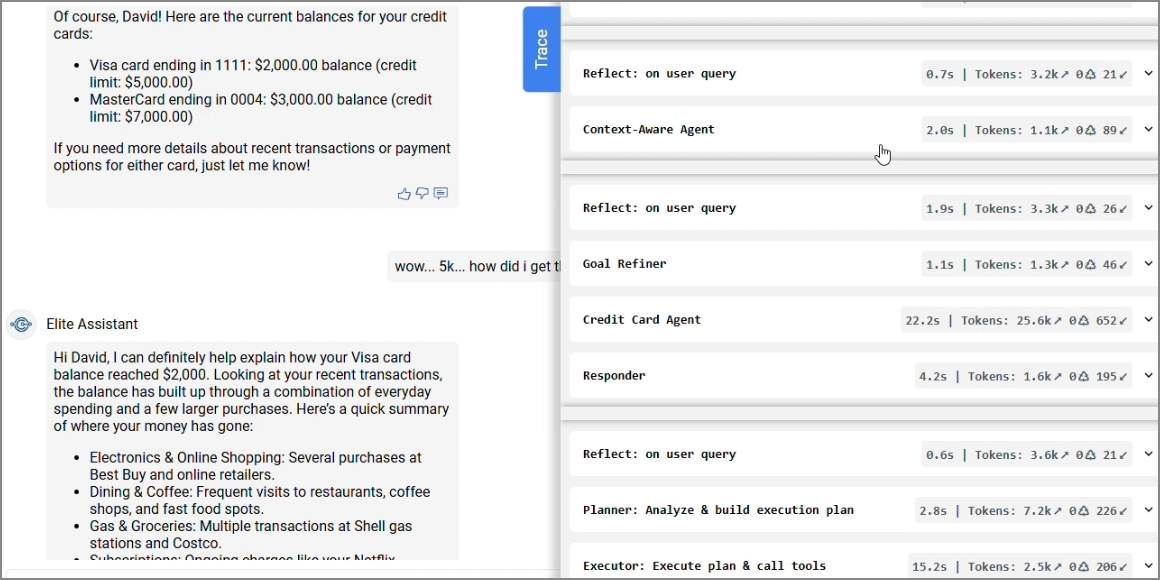
What a K2view trace looks like
A K2view trace includes a record of the conversation alongside a complete accounting of the tokens consumed and the time spent every step of the way.
12
Conclusion
AI applications fail differently than traditional software, so you must evaluate them differently.
Before you ship, evaluation tells you how well the application is likely to answer in production, based on prepared cases in a controlled environment. Although that’s a strong indication of quality, it’s no guarantee.
Observability tells you how the application responds once real customers are using it and keeps the record that lets someone confirm a problem and send dev the full trace.
Run the two as one loop, with the same criteria on both sides, and AI quality becomes something you can measure and improve.
The part most teams miss is being able to reproduce a failure. Without the context behind an answer, you can’t judge it and you can’t debug it.
K2view delivers governed business context, a full record of every interaction, and a saved copy of that context so you can run any session again.
Book a demo to see how it works in practice.
13
FAQs
1. What’s the difference between AI evaluation and AI observability?
Evaluation scores the AI’s answers against criteria you set, before deployment and then continuously in production. Observability records what the application did once real customers started using it.
2. Why do AI applications pass evaluation and still fail in production?
Because evaluations run in a controlled environment, and production isn’t one. Providers update models, teams edit prompts, and the business context the application reads keeps moving. An evaluation that passed last week was measuring a different system.
3. What is LLM-as-a-judge, and can you trust it?
LLM-as-a-judge means using one language model to score another model’s answers. It isn’t perfect, but it can review thousands of answers in the time a person reviews a few dozen. Have a person score the same answers first and measure how often the two agree, and keep fixed rules for decisions where an opinion isn’t good enough.
4. What’s the difference between online and offline evaluation?
Offline evaluation runs against prepared cases before the application reaches production. Online evaluation applies the same scores to real customer traffic, which is what turns observability data into a quality signal. Using the same criteria for both is what makes the two sets of results comparable.
5. What do you need to debug an AI failure?
You need the full record of the interaction, plus the context the application ran on at the time: the data it read, the version of the model, the tools it could reach, the customer it was serving, and the policies in force. Without those, you can see what the AI said but not why it said it.
6. How does K2view support AI evaluation and observability?
K2view provides masked, reusable production data, or synthetic data as needed, for every eval case. It scores the answers against your own criteria and shows live behavior on dashboards. It also saves the full record and the customer context behind each interaction, so anyone can replay a session and fix what went wrong.
Complimentary DOWNLOAD
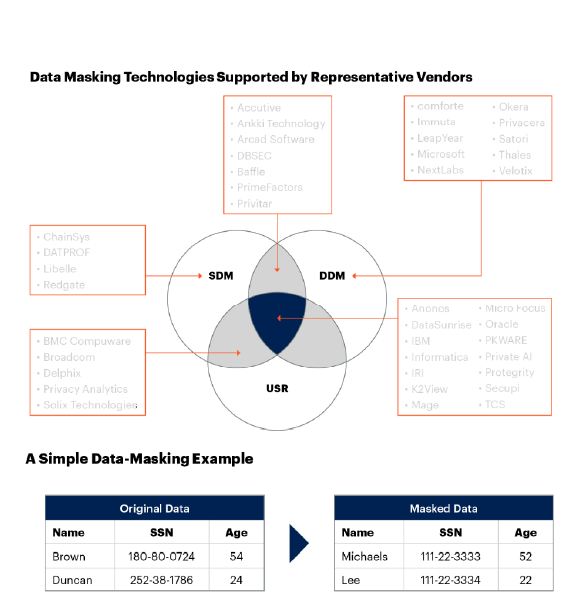
Free Gartner Report: Market Guide for Data Masking
Learn all about data masking from industry analyst Gartner:
-
Market description, including dynamic and static data masking techniques
-
Critical capabilities, such as PII discovery, rule management, operations, and reporting
-
Data masking vendors, broken down by category