
🎉 K2view named a Visionary in Gartner’s latest Magic Quadrant for Data Integration

Read More
Start Free
Book a Demo

A practical guide to data governance in the era of AI

What is AI data governance?

Last updated on May 25, 2026
Frame 238581-1
Send me as a pdf

tableicon/Table of Contents

Data governance is evolving from controlling data assets to governing runtime context for agentic AI.

Get Gartner Report

01

Key takeaways

  • Traditional data governance governs enterprise data through quality, privacy, access, lineage, and compliance controls. 

  • AI data governance extends those controls to the data used to train, ground, and operate AI systems. 

  • Agentic AI data governance adds live controls, so AI gets the right data for the right task, entity, and moment. 

  • More data often makes agentic AI reliable by adding noise, risk, and cost. 

  • Strong governance limits unnecessary exposure, applies policy before reasoning, and controls what the system can do next. 

02

Why AI data governance is changing

Traditional data governance tools were built for a world of stable data flows. Data moved through pipelines, landed in governed stores, and was used in fairly predictable ways. The job of governance was to make that data trusted, protected, and compliant.

AI changed that model. Instead of using data only for reporting, analytics, or model training, enterprises now use it to ground prompts, support decisions, and drive automated workflows. That’s why enterprise AI data governance has become a distinct challenge rather than just an extension of traditional governance.

Agentic AI changes it again.

Once an AI system can pull data from multiple sources, combine structured and unstructured information, reason across it, and trigger an action, governance can’t stop at the source system or the dataset. It has to control what information the system receives for a specific task, under specific policies, before it reasons or acts.

That’s the shift. AI data governance is no longer only about governed data at rest. It’s also about governed context in motion.

03

What’s the difference between traditional data governance, AI data governance, and agentic AI data governance?

Traditional data governance governs enterprise data through policies for quality, access, privacy, lineage, and compliance.
AI data governance extends that foundation to the data used to train, ground, and operate AI systems.

Agentic AI data governance goes a step further. It governs the information, policy checks, and action boundaries involved in live AI workflows.

The difference matters because the unit of governance changes. In traditional environments, the focus is the data asset. In AI, it expands to model inputs and retrieval. In agentic AI, the real control point is the live context assembled for a task.

Dimension    

Traditional data governance

AI data governance

 Agentic AI data governance

Primary focus

Enterprise data assets

Data used by AI systems

Operational context and controlled action

Unit of control

Tables, files, pipelines, domains

Training data, prompts, retrieval, model inputs

Task-scoped, entity-scoped live context

Main concern

Quality, privacy, access, lineage

Trustworthy and compliant AI inputs

Correct information before reasoning and action

Timing    

Before use, in stable flows

Before and during AI use


Precision needed

Broad policy-based control

Higher relevance for better outputs

High precision for the exact task and entity

Policy enforcement

At the data store and access layer

At the AI input and usage layer

Before reasoning and before action

Risk of failure

Bad reporting, misuse, compliance gaps

Poor outputs, leakage, weak grounding

Wrong decisions, unsafe actions, weak auditability


04

What are the core components of AI data governance?

The foundations still matter. Enterprises still need the basics right. But for AI, and especially for agentic AI, those basics have to extend into how data is assembled and used at runtime. The core components of AI data governance include:

  • Data quality and integrity
    If the data is wrong, stale, incomplete, or inconsistent, the AI outcome won’t be trustworthy. That’s true whether the system is generating an answer or taking an action.

  • Access, privacy, and security
    Governance has to determine who can access what, under what conditions, and with what protections. That includes masking, role-based controls, retention policies, and safeguards for sensitive data.

  • Lineage and traceability
    Enterprises need to know where data came from, how it was transformed, and how it influenced an output, recommendation, or action.

  • Ownership and accountability
    Governance doesn’t work without ownership. Someone has to own the data, the policies, and the outcomes.

  • Context control for agentic AI
    This is the new layer. For agentic AI, governance must control what information is assembled for a specific task, entity, and moment. That’s what determines what the system sees, how it reasons, and whether it should act at all.

05

Why does context matter so much in agentic AI?

Context determines behavior.

If the information is incomplete, the output is unreliable. If it’s stale, the decision may be wrong. If it’s too broad, the system gets noisy, expensive, and harder to control. If it includes sensitive data that shouldn’t be there, governance has already failed.

That’s also why data privacy in AI can’t be treated as a separate issue from governance. In agentic systems, privacy risk often shows up inside the live context window, not just in the source system.

Take an AI agent handling a billing dispute.

To resolve the issue safely, the agent may need the customer’s current account details, latest invoice, payment status, usage tied to the disputed charge, recent plan changes, prior dispute history, current refund policy, and the limits on what that agent is allowed to do.

What it should NOT get is broad access to unrelated accounts, unnecessary identity data, or years of customer history that have nothing to do with the dispute.

Therefore, for agentic systems, AI data governance should include 5 core controls: 

  1. Task-based access
    The AI should access only the data required for the task it is performing. 

  2. Precisely scoped context
    The AI should receive context limited to the customer, claim, order, account, or device involved in the task. 

  3. Runtime policy enforcement
    Privacy, masking, compliance, consent, security policies, and access controls should be enforced at runtime, based on the task, user, agent, entity, and operational instance.

  4. Freshness and state awareness
    Operational AI must work from current state, not just historical records. 

  5. Controlled action and traceability
    If the system can trigger workflows, update records, or call tools, those actions must be audited and traceable. 

Without these controls, the same agent could miss a recent payment, expose sensitive information, or approve an action it was never supposed to take.

That’s why the real governance question is no longer just, “Is the source data governed?” It’s also, “Did the AI get the right information for this task, under the right constraints, at the right time?”

06

Agentic AI data governance challenges and benefits

Agentic systems must pull together information across documents, APIs, operational systems, tools, and memory. That makes governance harder at the exact moment it matters most.

Challenges

The main challenges include:

  • Over-broad retrieval 

  • Stale operational data 

  • Sensitive data exposure \

  • Inconsistent policy enforcement 

  • Unclear action boundaries 

  • Weak traceability across decisions and actions 

And this is where many enterprise AI programs go wrong. When results are weak, the instinct is to widen access to include more tables, more documents, more APIs, and more history.

But that usually makes the system less reliable.

More access creates more ambiguity, more privacy exposure, more token cost, and more governance complexity. In agentic AI, that’s not just a quality issue. It’s an operational risk.

Benefits

When done right, governance becomes an enabler, with clear benefits including:

  • Less noise and better output quality 

  • Lower privacy and compliance risk 

  • Less unnecessary data exposure 

  • Better control over downstream actions 

  • Stronger auditability 

  • Safer production use of agentic AI 

In short, agentic AI doesn’t need more context. It needs precise operational context.

07

AI data governance best practices

The most useful AI data governance best practices are the ones that hold up in production:

  1. Start with governed source data
    Data quality, privacy, access control, lineage, and stewardship still matter. Agentic AI doesn’t eliminate foundational governance. It raises the cost of getting it wrong.

  2. Define task-level requirements
    For each workflow, decide what the AI actually needs and what should stay out. Governance should begin with the task, not with broad access to source systems.

  3. Scope information to the business entity
    The customer, claim, order, account, device, or case should define the boundary of relevant information. That’s how you reduce noise and control exposure.

  4. Apply policy before reasoning
    Masking, exclusions, permissions, retention, and compliance controls should be applied before the model processes the data. Not after.

  5. Control downstream actions
    Recommendation isn’t the same as execution. Agents should operate within clear limits for what they may trigger, update, approve, or escalate.

  6. Add traceability and review
    Enterprises need to see what data was assembled, what controls were applied, and what actions were taken. That’s how you support trust, compliance, and continuous improvement.

08

Where does agentic AI data governance matter most?

Agentic AI data governance matters most in operational use cases, where bad context doesn’t just produce a weak answer. It produces the wrong action.

  • Customer service
    An agent needs current customer information, not broad access to every record.

  • Billing disputes
    The system needs the latest invoice, usage, payment state, refund policy, and action limits.

  • Claims handling
    The AI should receive only the claim, claimant, relevant documents, and current policy rules.

  • Fraud review
    Governance must control access to sensitive data, current signals, and permitted investigative actions.

  • Loan processing
    The system should reason over the correct applicant, supporting records, and policy rules without exposing unrelated financial data.

  • Employee support
    Internal agents need scoped access to the employee, request, entitlements, and workflow actions involved.

These are all workflows where wrong context leads to wrong outcomes.

09

Why governance also supports compliance and accountability

Governance isn’t only about improving outputs. It also helps enterprises explain what data influenced a result, what policies were applied, what actions were taken, and who was accountable.

That matters even more for agentic AI because the system may move from retrieval to action in one flow. Auditability has to cover both the information used and the outcome produced.

This is also where AI data compliance becomes operational. It’s not just about proving that policies exist. It’s also about enforcing them when the AI assembles information, reasons over it, and triggers an action.

This is where traditional governance falls short. It can tell you who may access a system or a table. But it can’t tell you what an AI system should receive to resolve a live dispute, review a claim, or trigger a workflow.

That requires enforcement at the point of use.

10

How K2view governs agentic AI

Enterprises already know that sensitive data should be protected, that AI shouldn’t see everything, and that actions should be controlled. But they have a hard time making that governance operational across fragmented systems, mixed data types, and live workflows.

That’s where K2view fits in.
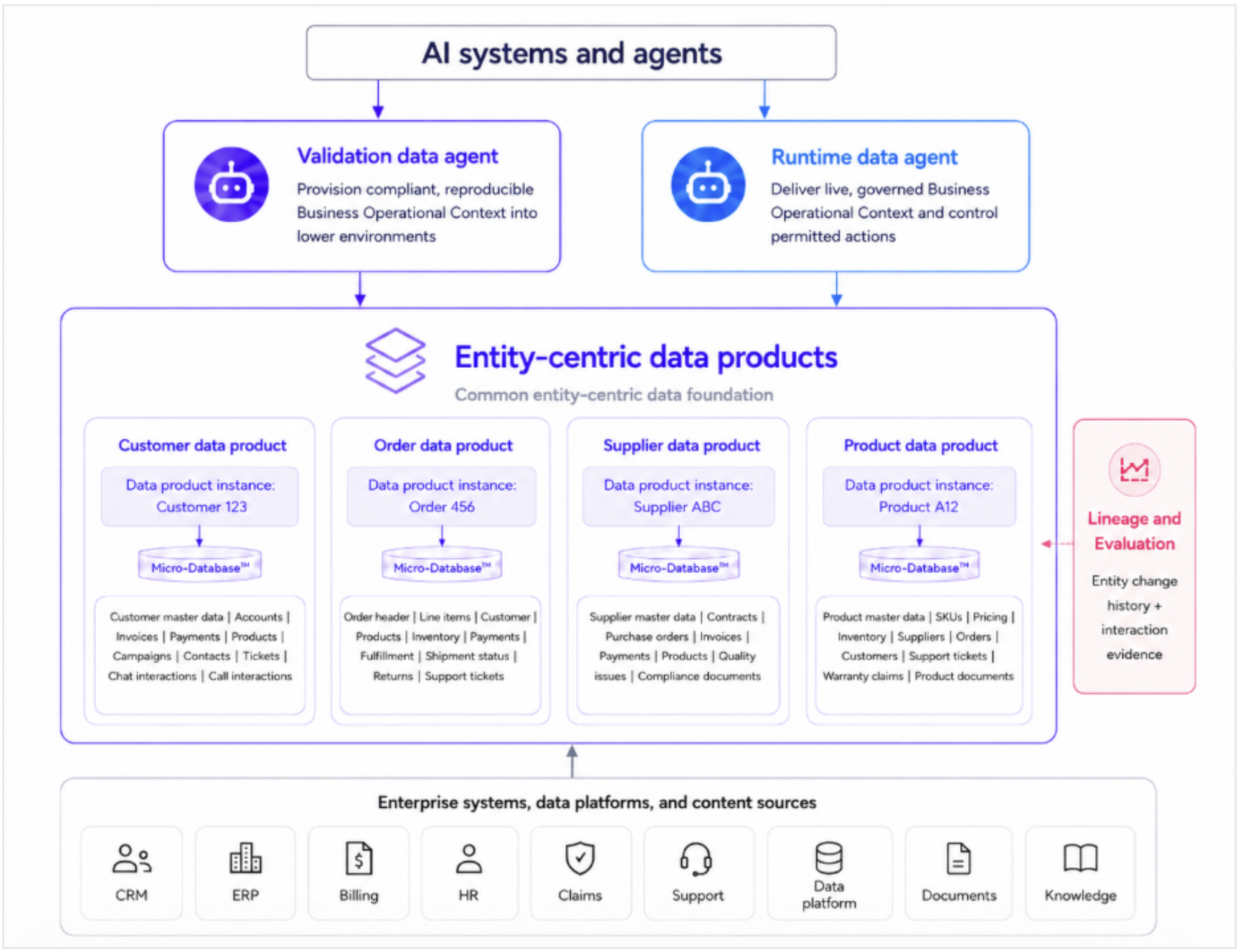
The K2view approach is built around entity-centric data products and runtime data agents.

The data product organizes trusted business data around real operational entities such as customers, claims, invoices, accounts, or orders.

The data agents coordinate between enterprise systems and AI agents to interpret the request, identify the relevant entity, retrieve the right information, apply the required controls, and support governed action downstream.

Data agents prevent the AI agent from becoming the integration layer, the security layer, and the policy engine all at the same time. The AI agent should get the right context, already scoped and governed for the task at hand.

K2view provides practical AI data governance tools that help enterprises deliver governed, entity-based data and apply policy before AI reasons and takes action.

11

Conclusion

AI data governance is evolving. Traditional governance still makes enterprise data trusted, protected, and fit for use. But agentic AI adds a new requirement: controlling the information, policies, and actions involved in live workflows.

That means limiting data to the task and entity involved, applying policy before reasoning, and setting clear boundaries for action. AI data governance isn’t about broader access. It’s about more precise, governed execution.

K2view makes AI data governance a reality with entity-centric data products and runtime data agents. Book a demo to see how it works in practice.

12

FAQs

How is agentic AI data governance different from AI data governance?

AI data governance governs the data used by AI systems. Agentic AI data governance adds live controls for task-specific information, policy enforcement, and action boundaries.

Does agentic AI data governance replace traditional data governance?

No. Traditional data governance remains the foundation. Agentic AI data governance extends it into live workflows.

Why isn’t design-time governance enough?

Because agentic systems retrieve data and act dynamically. Policies have to be enforced when information is assembled, not only when source systems are designed

What should be governed at runtime?

At a minimum: Task scope, entity scope, current state, data scope, policy controls, traceability, and action limits.

What’s the biggest mistake enterprises make?

Giving the AI too much data. Broad access often creates more noise, more exposure, and less control than precise, task-scoped information.

How does K2view support runtime AI governance?

K2view uses entity-centric data products and runtime data agents to deliver the right data and apply policy before AI reasoning and action.

Complimentary DOWNLOAD

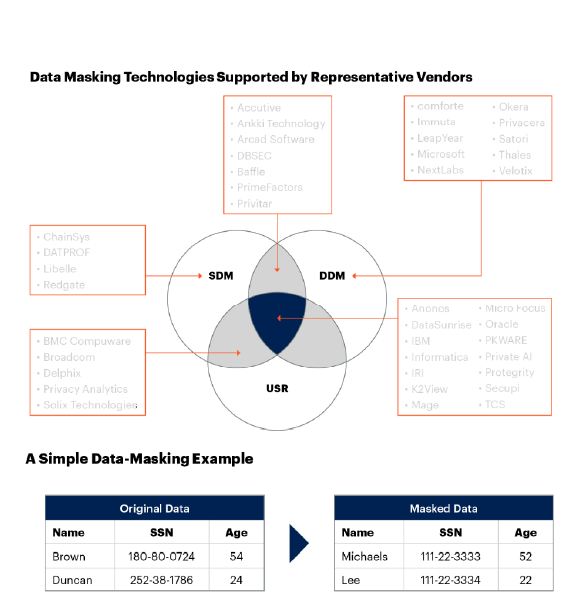
Free Gartner Report: Market Guide for Data Masking

Learn all about data masking from industry analyst Gartner:

  • Market description, including dynamic and static data masking techniques

  • Critical capabilities, such as PII discovery, rule management, operations, and reporting

  • Data masking vendors, broken down by category

Get Whitepaper
Data masking technologies by Gartner
Gartner® Market Guide for Data Masking Get Gartner Report