
The enterprise guide to managing AI context
What is AI context management?
Last updated on September 17, 2026
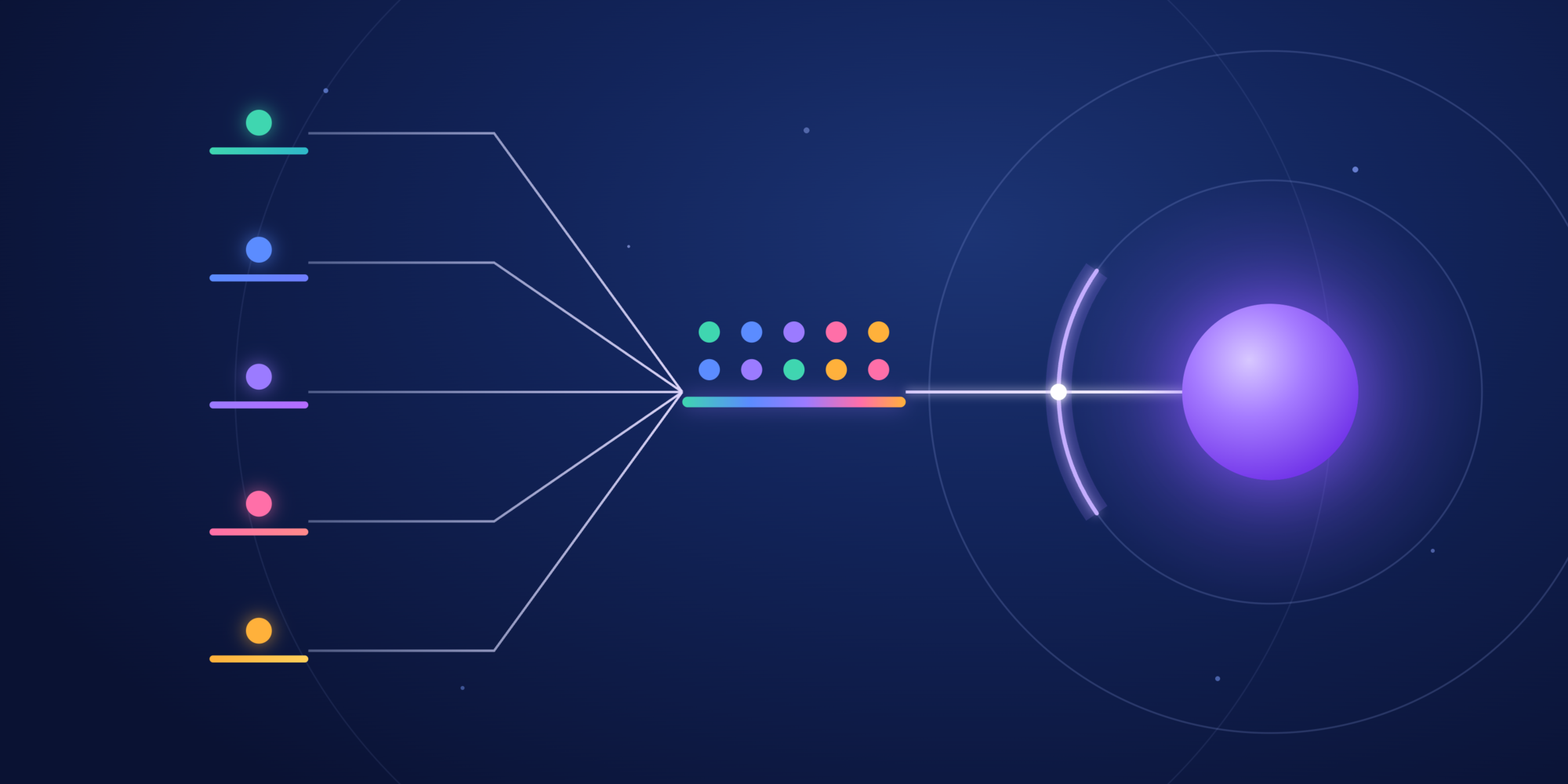
AI context management assembles, governs, and delivers the context AI systems need. Learn how it differs for analytical and operational AI use cases.
01
Key takeaways
-
AI context management is the discipline of assembling, governing, and delivering the context an AI interaction requires, while keeping the evidence needed to evaluate and replay it.
- The use case decides what context AI needs, how that context must be managed, and which architecture supports it.
- Analytical AI needs consistent definitions and governed queries across many records. Operational AI needs current, entity-level context and the authority to act for a specific customer, account, or order inside a live workflow.
- Semantic models, ontologies, knowledge graphs, and context graphs give AI the business meaning and relationships it needs to interpret enterprise data.
- AI context platforms enable AI context management, and AI context assurance is the outcome.
02
What is AI context management?
AI context management is the discipline of assembling, governing, and delivering the context an AI interaction requires, while preserving the lineage and interaction state needed to evaluate its outcome and replay the interaction with the context used.
Consider two questions an AI agent might receive:
-
Analytical: Why did customer churn increase last quarter?
-
Operational: This customer is requesting cancellation now. What retention offer are they eligible for, and can we apply it?
Both questions need business meaning, relevant data, governance, and traceability. The second also needs the customer’s current state, a timely decision, and authorization for any action that follows. AI context management is how an enterprise meets both sets of requirements.
AI context can include:
- Business meaning, such as definitions, metrics, and rules
- Relevant structured and unstructured data
- Relationships between business entities
- Related history
- Policies that govern the task
- Permitted actions, where the task requires them
Both questions need business meaning, relevant data, governance, and traceability. The second also needs the customer’s current state, a timely decision, and authorization for any action that follows. AI context management is how an enterprise meets both sets of requirements.
AI context can include:
The scope of that context depends on who’s asking, the task, and the business entities involved. Three related terms describe how the pieces fit together:
-
AI context management
This is the discipline: the practices that decide how context is assembled, governed, delivered, and recorded. -
AI context platform
This is the system that enables the discipline. It combines underlying technology with services, interfaces, and controls, so context capabilities can be reused across applications and agents. -
AI context assurance
This is the outcome: confidence that each interaction received the right context under the right controls, with the evidence to show it.
03
How do analytical and operational AI differ?
Analytical AI democratizes access to insights. Business users across the organization can ask questions, explore patterns, and understand performance without waiting for a specialist analyst. AI agents translate those questions into governed queries and explain what they find.
Operational AI supports decisions and actions within business workflows. AI agents consume context about specific customers, accounts, orders, or other entities to recommend or carry out the next step. They may act on their own or assist employees, within the permissions and controls set for the task.
In both cases, AI agents are the ones consuming context. What differs is the task. For example, an analytical agent tells you what happened across many customers, over time. An operational agent resolves one customer’s issue, right now.
The two often work together. An analytical agent might show that customers on older plans churn the most, and the business responds with a new retention offer. Later, during a live call, an operational agent checks one customer’s plan, usage, and eligibility, and applies that offer.
04
How does the use case shape context requirements?
Both types of AI need the same kinds of context, from scope and freshness to governance and evidence. What changes is the emphasis, as the table shows. The split isn’t strict. Some analytics needs real-time data, and some operational agents only recommend an action instead of taking it.
|
Requirement |
Analytical focus |
Operational focus |
|
Context scope |
Metrics, dimensions, datasets, and business definitions |
Specific entities, current state, relationships, eligibility, and available actions |
|
Freshness |
Current enough for the analytical question |
Current enough for the decision and action at hand |
|
Latency |
Fast enough for exploration and analysis |
Fast enough for the interaction or workflow |
|
Governance |
Governed access, analytical rules, and deterministic controls |
Access permissions, task boundaries, action authorization, and deterministic guardrails enforced in code at runtime |
|
Operations |
Retrieve, analyze, explain, and recommend |
Retrieve, decide, recommend, and, where authorized, update systems or execute actions |
|
Evidence |
The question, definitions, data, and outputs, kept for evaluation and replay |
Point-in-time context, controls, operations, outputs, and results, kept to evaluate the outcome and replay the interaction |
In the churn question, an answer that uses yesterday’s data is usually fine. In the cancellation request, an offer based on yesterday’s account status can be wrong, and an offer applied without authorization can’t simply be taken back.
05
What are the four capabilities of AI context management?
AI context management rests on four capabilities:
-
Context assembly
Assembly connects relevant information with its business meaning. Some of the work is reusable preparation done ahead of time, such as modeling entities and mapping sources. The rest happens at request time, when the context for one interaction is pulled together from structured and unstructured sources, entity relationships, and relevant history, at a freshness that suits the task. -
Context governance
Governance enforces access, privacy, entity and task scope, and permitted operations throughout the interaction. Deterministic guardrails run in code at runtime, so policy doesn’t depend on the model following instructions. A model can ignore a rule written in a prompt, but it can’t see data that was never delivered. -
Context delivery
Delivery supplies precise context at the required freshness and speed, through suitable tools and interfaces such as MCP, APIs, SQL, and RAG. Where actions are involved, it supports authorized execution and returns the results. Precision matters, because a model flooded with marginal information suffers from context rot, and its accuracy declines as the context grows noisier. -
Context lineage and playback
Lineage preserves the request, sources, context used, controls applied, operations performed, captured outputs, and relevant evaluation results. It keeps the point-in-time state needed to investigate an outcome and replay the interaction with its context.
Playback means inspecting a recorded interaction. Replay means re-executing it with the captured context in a controlled environment. Replay may produce different model outputs, and any action that updates a system needs controlled handling, such as running against a non-production environment.
Captured interactions also make evaluation possible. Teams can evaluate each outcome against the context the agent actually used, then feed what they learn back into context assembly, policies, prompts, and tools.
Here’s how each capability applies to the two opening questions:
|
Capability |
Why did churn increase last quarter? |
What offer can this customer get now? |
|
Assembly |
Churn definitions, customer segments, and quarterly data |
The customer’s plan, tenure, usage, open cases, and offer eligibility rules |
|
Governance |
Access to governed datasets and approved metric logic |
Permission to view this customer, offer limits, and authorization to apply the offer |
|
Delivery |
Governed queries that return consistent results |
Current entity context during the call, plus execution of the approved offer |
|
Lineage and playback |
The question, definitions, queries, and answer |
Point-in-time customer state, controls applied, the offer made, and the confirmed result |
06
How do you provide the business meaning and knowledge AI context management requires?
AI needs a semantic foundation to interpret enterprise data correctly. Four related approaches provide the business meaning and relationships it depends on:
-
Semantic modeling
Semantic models define business concepts, attributes, relationships, and rules, including how source data maps to them. For example, outstanding balance means unpaid charges, with a defined currency and treatment of credits. -
Ontologies
Ontologies formalize concepts, relationship types, hierarchies, and constraints. Paired with reasoning capabilities, they can support inference. For example, a mobile subscription is a type of subscription, and a customer holds subscriptions, which are governed by contracts. - Knowledge graphs
Knowledge graphs connect specific entities and facts through explicit relationships, so AI can discover and traverse relevant context across entities. For example, Customer 123 holds Subscription 456, governed by Contract 789, which includes an early termination condition.
- Context graphs
Context graphs record the decisions made in past interactions, along with the data, rules, and approvals behind them, so agents and teams can trace outcomes and learn from precedent. For example, a retention offer was approved for Customer 123 because their contract included an early termination condition.
These approaches overlap, so choose by the business meaning, relationship traversal, and reasoning the use case requires. What gets modeled depends on the workload:
- Analytical workloads
Model metrics, dimensions, business definitions, and relationships, so AI can interpret questions, query governed data, and explain findings consistently.
- Operational workloads
Model business entities, their current state, cross-entity relationships, applicable policies, and available actions, so AI can support decisions and take part in workflows.
Operational workloads also need a runtime architecture around the semantic foundation, including:
- Synchronization with operational systems
- Timely context delivery
- Runtime authorization and deterministic guardrails
- Governed read and write operations
- Point-in-time interaction capture for evaluation and replay
Together, these make up the context layer: the architecture that sits between enterprise information and AI. Gartner describes the context layer in terms of semantics, operational state, and provenance, which map closely to the semantic foundation, the runtime architecture, and lineage described here.
An AI context platform is the system that implements and manages the context layer’s capabilities. It combines underlying technology with services, interfaces, and controls, so those capabilities can be reused across applications and agents instead of rebuilt for each one.
07
What is AI context assurance?
AI context assurance is the outcome of AI context management, measured against the use case. It means each interaction gets:
- Precise context
- Appropriate freshness and delivery speed
- Enforced permissions and guardrails
- Authorized actions, where the task requires them
- Outcomes evaluated against the context used
What assurance looks like depends on the workload:
- Analytical interactions
Assurance means consistent interpretation, governed answers, and the ability to trace each answer back to its definitions and data.
- Operational interactions
Assurance means timely decisions, permitted actions, confirmed execution results, and retained evidence of what happened.
Evaluation and replay drive investigation and continuous improvement. Use evaluation for graded or subjective assessments, such as whether the agent’s explanation of the offer was clear. Use testing for deterministic pass/fail checks, such as whether the agent stayed within the offer limit.
The business value shows up in four places:
-
Better customer and employee experiences
-
Higher operational efficiency
-
Faster rollouts, because new agents reuse existing context
-
Faster investigation of unacceptable outcomes
Context assurance has limits. It can’t guarantee flawless model reasoning or instruction-following. What it does provide is confidence that the model received the right context under the right controls, and a clear record of what happened afterward.
08
How K2view enables AI context management
K2view focuses on business operational context: the context AI needs to act on specific customers, accounts, and orders inside live workflows.
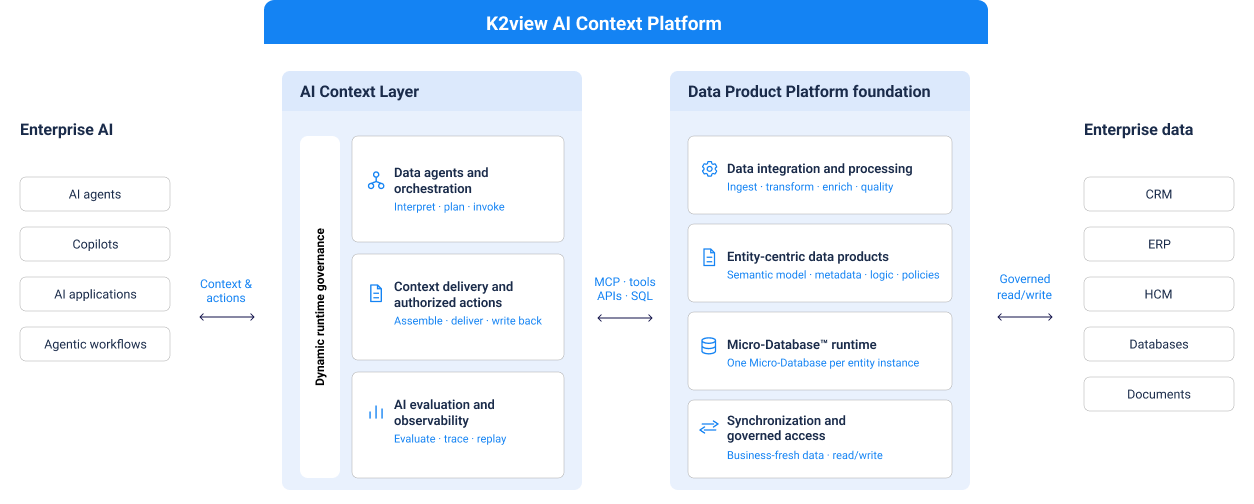
The K2view AI Context Platform extends the K2view Data Product Platform with an AI context layer, and delivers four solutions:
-
Entity-centric, AI-ready data products
AI-ready data products are organized around business entities, such as a customer or an order. They provide the semantic foundation and keep context synchronized across distributed enterprise systems. -
Data agents for context delivery
Data agents assemble precise context and orchestrate governed data operations at conversational speed. -
AI runtime governance
Runtime governance enforces access, task boundaries, authorized actions, and deterministic guardrails on every request. -
AI evaluation and observability
Evaluation and observability captures interactions and their context for investigation, outcome evaluation, and replay.
K2assistant, the platform’s built-in AI assistant, creates data products, data agents, and evaluations from plain-language descriptions, so teams can move from use case to working implementation quickly.
The platform’s data products are built on Micro-Database™ technology. Each business entity, such as one customer, gets its own isolated store that holds its data from every source system, kept in sync and served in milliseconds. That’s how the platform delivers current, entity-level context during a live interaction and keeps the point-in-time state needed for replay.
K2view’s catalog and data product models capture business meaning, entity relationships, and associated rules. Each Micro-Database instantiates that model with the current facts and relationships for a specific business entity, providing connected operational context that AI can query and act on through governed operations.
K2view captures execution through its managed layer: the context delivered, the controls applied, the operations performed, and their results.
09
Conclusion
AI context management is the discipline of assembling, governing, and delivering the context an AI interaction requires, while keeping the evidence needed to evaluate and replay it. The use case shapes everything.
Analytical AI needs consistent meaning and governed answers.
Operational AI also needs current entity state, runtime authorization, governed actions, and point-in-time evidence.
An AI context platform makes these capabilities reusable, and AI context assurance is the result.
K2view supports AI context management for operational AI with entity-centric data products, data agents, runtime governance, and evaluation and observability.
13
FAQs
1. How is AI context management different from context engineering?
Context engineering designs the information one agent receives at each step. AI context management applies those practices across every agent in the enterprise, with shared definitions, policies, and lineage, so each team doesn’t rebuild context for its own agent.
2. What is context rot?
Context rot is the decline in a model’s accuracy and reasoning as its context grows longer and noisier. It sets in well before the context window is full, which is why precise context matters more than large context.
3. What’s the difference between AI context and training data?
Training data shapes what a model learns, and it’s fixed once training ends. AI context is supplied with each request, so it can reflect current information about a business, user, or task.
4. Does AI context management replace semantic layers or data catalogs?
No. Semantic layers and data catalogs provide business meaning and metadata that AI context management builds on. Operational AI also needs current entity data, runtime authorization, and governed actions, which those tools weren’t designed to provide.
5. Who owns AI context management in an enterprise?
Ownership is usually shared. Data teams own entity models and integrations, domain teams own definitions, security teams own policies, and AI teams own the agents.
Complimentary DOWNLOAD
Free Gartner Report: Market Guide for Data Masking
Learn all about data masking from industry analyst Gartner:
-
Market description, including dynamic and static data masking techniques
-
Critical capabilities, such as PII discovery, rule management, operations, and reporting
-
Data masking vendors, broken down by category
Related articles for you
gartner report
A practical path to unified data governance for AI success
Market Survey
The State of Enterprise Data Readiness for GenAI in 2026