

Data masking solutions for de-identification: Compare top tools and features
Backed by Gartner’s market guide for data masking
Modern data masking solutions help organizations protect sensitive data through de-identification, obfuscation, tokenization, and synthetic data generation for compliance, testing, analytics, and AI use cases.
Use the Gartner guide to compare data masking and de-identification tools based on:
-
Static vs dynamic data masking approaches
-
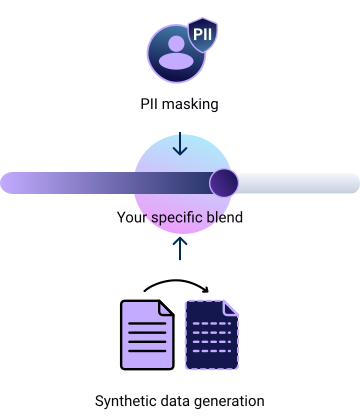
PII masking, data de-identification, and tokenization methods
- Data utility vs privacy tradeoffs
-
Vendor capabilities and solution selection criteria
Get the Gartner report
Key capabilities to compare in data masking solutions
Review de-identification techniques
Benchmark PII masking, tokenization, de-identification and synthetic data generation across key use cases.
Compare data protection capabilities
See how each solution supports PII discovery, compliance, automation, and data utility.
Balance privacy and usability
Maintain data fidelity and usability across non-production environments without risking compliance.
Evaluate masking tools and vendors
Review Gartner’s market perspective of best tools, key capabilities, and criteria for evaluating available solutions.
Why data masking approaches are evolving
Organizations need to protect sensitive data while keeping it usable for testing, analytics, AI, and compliance.
That’s why teams compare data masking tools, techniques, and approaches.
- Testing and development: Need realistic, production-like data without exposing PII
- Analytics and AI: Require high-fidelity, privacy-safe datasets
- Evolving privacy regulations: Depend on reliable masking, tokenization, and de-identification
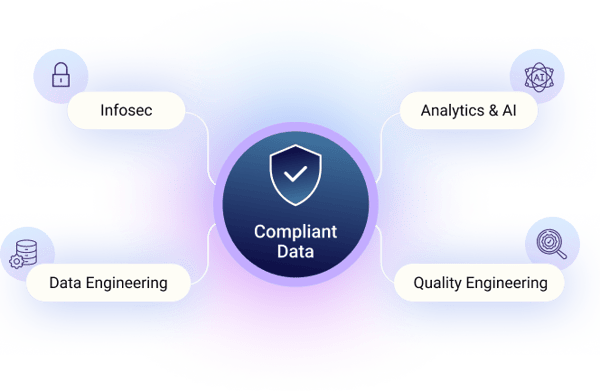
Who this guide is for
- Infosec: Compare data masking, de-identification, and compliance methods
- Data engineering: Preserve referential integrity while protecting sensitive data
- Analytics & AI: Access high-fidelity, privacy-safe data for analytics and AI
- Quality engineering: Use production-like test data without exposing PII