





Table of contents
K2view TDM removes the test data bottleneck for AI-assisted software delivery, leveraging our new Test Case Data Agent to instantly provision data straight from test cases to match the rapid pace of generated code.
Key takeaways
-
Your current K2view TDM remains valid and essential.
-
AI-assisted development is creating more test scenarios than manual test data workflows can support.
-
Our Test Case Data Agent adds an agentic AI layer to your existing K2view TDM tool.
-
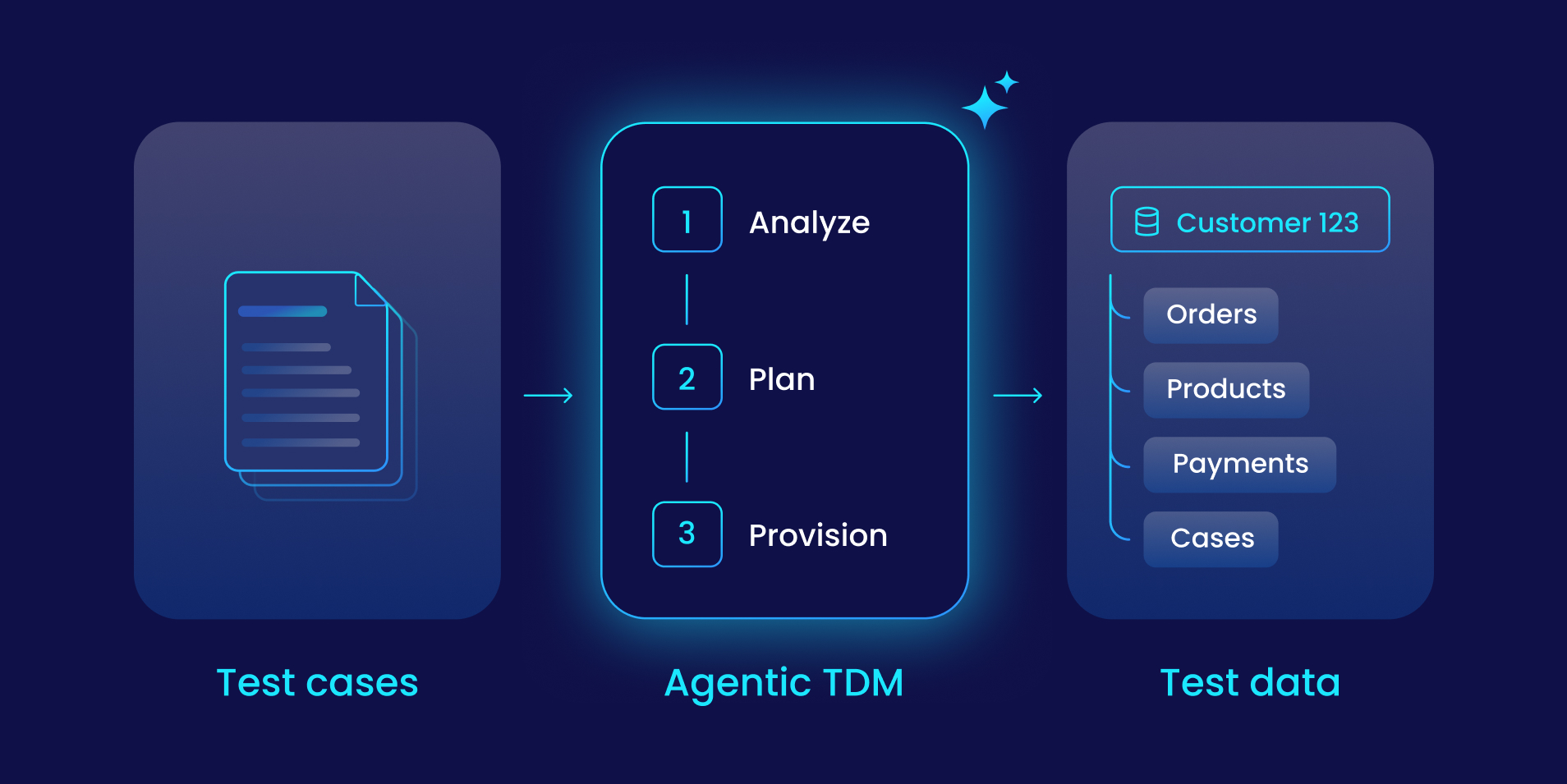
It interprets user stories, test cases, scripts, and requirements, then creates a provisioning plan.
-
The result is Agentic TDM: Compliant test data delivered faster, with far less manual effort.
Why does your current K2view TDM tool need an agentic layer?
K2view Test Data Management provisions realistic and compliant test data subsets to lower environment, with support for synthetic data generation, aging, reservation, rollback, and more. .
AI-assisted development enables developers, QA engineers, business users, and external partners to generate software code and test cases in minutes instead of days or weeks. That means more test scenarios, more edge cases, and more variations to test.
The challenge is no longer whether test data exists. It’s whether the right test data can be identified, composed, protected, and delivered fast enough for each test case.
That’s where K2view’s new Test Case Data Agent comes in.
It turns your current K2view TDM tool into Agentic TDM by adding an AI-driven layer that reads your test cases to understand what needs to be tested and orchestrates the right test data actions through the K2view platform.
What changes when you deploy the Test Case Data Agent?
Up till now, QA or platform teams would be required to translate every test data requirement into the corresponding data provisioning tasks in K2view TDM.
This means determining which data subset conditions are required, the relevant business entities involved, setting reservation and environment parameters, selecting the most appropriate synthetic data generation method, and sequencing the tasks to be performed in the correct order.
That process worked for traditional development. At AI speed, it becomes a bottleneck.
The K2view Test Case Data Agent removes all of that manual translation. It connects to requirements and test management tools, such as Jira, and interprets the intent of each test case. It identifies the test data needs, determines whether the test case can be satisfied with masked production or cloned data, and decides when synthetic data is required.
Then it creates and executes a tailored test data provisioning plan.
Testing and development teams no longer need to request test data. K2view Agentic TDM handles the test data provisioning automatically, based on the test cases. The result: faster test data provisioning tailored to the test cases you need to run.
How does Agentic TDM work in practice?
Agentic TDM starts by reading the test cases.
The Test Case Data Agent analyzes the the test cases and identifies the data needed for complete test coverage.
For example, a test case may require a customer service representative to see an overdue payment warning in the CRM when opening the profile of a customer who owes more than $100, has been overdue for more than 30 days, and is not yet in collections.
With Agentic TDM, the Test Case Data Agent interprets that requirement from the test case, identifies the customer entity, applies the required data subsetting parameters, retrieves matching data from the higher environment, and provisions the dataset to the test environment.
If matching data doesn’t exist in the higher environment, or if the scenario requires a rare condition or negative test, the agent triggers synthetic data generation, selecting the most appropriate method for the job: cloning, rules-based, or AI. It doesn’t create synthetic data by default when masked or cloned data is enough. It chooses the right approach for the requirement.
K2view Agentic TDM reasons through the test data needs, plans the best way to satisfy them, and orchestrates the required K2view tasks for the job.
What parts of your current K2view TDM investment does it use?
The Test Case Data Agent is an add-on to K2view TDM. It builds on existing capabilities, including:
-
Sensitive data discovery and classification
- Entity-level data masking
- Test data provisioning
- Data subsetting
- Entity cloning
- Synthetic data generation
- Natural-language interaction
- API-based integration with delivery workflows
The agentic layer doesn’t replace these capabilities. It applies at the speed of AI-assisted development.
For existing K2view customers, this is a practical next step. You don’t need to rethink your TDM architecture. You just need to extend it.
How does Agentic TDM improve day-to-day testing?
For QA teams, Agentic TDM means less time explaining data needs and more time on defining test requirements, and addressing risk, coverage, and failures.
For developers, it means faster access to the exact data required to unit test a change.
For platform teams, it means fewer one-off requests and less manual data preparation.
For compliance teams, it means sensitive data controls are applied through the same K2view enterprise AI data governance processes already used for masking, provisioning, and synthetic data generation.
For release leaders, it means test data doesn't delay the delivery pipeline.
The biggest change is that test data becomes test case driven.
Conclusion
AI-assisted development is changing the pace of software delivery, but faster code doesn’t create faster releases unless testing can keep up.
For existing K2view customers, the Test Case Data Agent is the next step: It adds agentic AI to K2view TDM, turning test cases into compliant, scenario-specific test data -- autonomously.
That’s how your K2view TDM investment becomes agentic. Request a demo to learn more.


